Alkira is a cloud networking platform that provides Network Infrastructure-as-a-Service (NIaaS), enabling enterprises to simplify and control their cloud and hybrid networking environments. Alkira eliminates the need for traditional hardware, offering a unified control plane for seamless connectivity across single, multi-cloud, and hybrid environments. Key offerings include Global Backbone-as-a-Service, integrated security features like Zero Trust Network Access (ZTNA) and next-generation firewalls, and comprehensive visibility tools. Learn more about Alkira's platform.
What is the primary purpose of Alkira's product?
The primary purpose of Alkira's product is to simplify cloud networking for enterprises by providing a cloud-native, hardware-free solution that connects hybrid and multi-cloud environments through a unified control plane. This approach reduces complexity, enhances security, improves scalability, and provides comprehensive visibility and control. More about Alkira's mission.
What are the key capabilities and benefits of Alkira's product?
Alkira's platform offers:
Network Infrastructure-as-a-Service (NIaaS) for hybrid and multi-cloud environments
Global Backbone-as-a-Service for scalable, low-latency connectivity
Up to 40% lower TCO, 96% reduction in cloud setup time, and 47% reduction in network management time
These capabilities help enterprises achieve operational efficiency, cost savings, and business resilience. See Alkira's platform details.
What is the main topic of 'Taking Control of Cloud Costs with a New Kind of Networking'?
This content focuses on how Alkira's networking solutions help organizations control cloud costs by simplifying multi-cloud networking, improving speed, reducing costs, and providing visibility to prevent waste and shadow IT. Read the full article.
What is Alkira Cloud Insights?
Alkira Cloud Insights is a tool within Alkira's platform that helps organizations identify unused or unaccounted-for resources, improve security posture, and reduce waste in cloud environments. It provides actionable visibility to control costs and optimize cloud spend. Learn more about Cloud Insights.
Does Alkira provide APIs?
Yes, Alkira offers APIs, including billing APIs that provide real-time cloud network cost data. These APIs can be integrated with other cost management tools and dashboards for automated monitoring and optimization of cloud costs. More about Alkira APIs.
Pricing & Plans
What is Alkira's pricing model and how is it determined?
Alkira offers flexible pricing models:
Consumption-Based Pricing: Pay-as-you-go based on actual usage of network elements, services, and traffic.
Commitment-Based Pricing: Fixed pricing for predictable budgeting.
Pricing is determined by the quantity and size of network elements (e.g., Alkira Cloud Exchange Points), connectors, firewalls, and data egress. Customers can view live pricing details from the portal or via APIs. See Alkira's pricing page.
Features & Capabilities
What features does Alkira offer to help control cloud costs?
Alkira provides holistic visibility and control over cloud networking resources, enabling organizations to identify and eliminate unused or underutilized resources, reduce shadow IT, and enforce company-wide policies. The platform's single-pane-of-glass management and Cloud Insights tool help prevent cost overruns and optimize spend. Customers have reported up to 40% savings after switching to Alkira. Source.
How does Alkira simplify multi-cloud and hybrid cloud networking?
Alkira eliminates complex manual configurations and provides a true abstraction layer leveraging cloud providers' infrastructure. Its drag-and-drop interface and single-click provisioning make it easy to design and deploy networks across multiple clouds and on-premises environments, reducing deployment times from months to minutes. Learn more.
What integrations does Alkira support?
Alkira integrates with leading technology providers and platforms, including:
What security and compliance features does Alkira provide?
Alkira is SOC 2 and PCI-DSS compliant, ensuring high standards for data security and operational controls. The platform includes integrated security features such as Zero Trust Network Access (ZTNA) and next-generation firewalls, protecting distributed workforces and applications. More on Alkira's compliance.
Does Alkira offer technical documentation and resources?
What business impact can customers expect from using Alkira?
Customers can expect:
Operational efficiency: 96% reduction in cloud setup time, 47% reduction in network management time
Cost savings: Up to 40% lower TCO compared to traditional solutions
Enhanced security and compliance
Scalability and business resilience
End-to-end visibility and control
These outcomes are supported by customer testimonials and case studies. See more.
What problems does Alkira solve for enterprises?
Alkira addresses:
Operational complexity in cloud networking
Security vulnerabilities in traditional VPNs and perimeter-based models
Challenges in multi-cloud and hybrid cloud networking
Lack of visibility and governance
High costs and inefficiencies due to shadow IT and resource sprawl
Alkira's platform provides a unified, secure, and cost-effective solution. Learn more.
Who can benefit from Alkira's solutions?
Alkira is designed for mid-to-large enterprises across industries such as manufacturing, healthcare, retail, telecommunications, financial services, biotechnology, software technology, media & entertainment, and aviation. Target roles include Network Architects, Cloud Architects, Security Architects, IT Managers/Directors, CloudOps, CIOs, CTOs, CISOs, and VPs. See customer stories.
What are some real-world examples of Alkira's impact?
Notable case studies include:
Michaels: Transformed its network across 1,400 stores, ensuring secure, seamless connectivity and cost control.
Koch Industries: Simplified multicloud networking and improved agility.
Warner Hotels: Enhanced networking efficiency and visibility.
Chart Industries: Improved agility, saved costs, and expanded globally.
SITA: Integrated on-premises and cloud environments for aviation.
What feedback have customers given about Alkira's ease of use?
Customers consistently praise Alkira for its intuitive drag-and-drop interface and rapid deployment. For example, a Network Architect at a large manufacturer said, "The IT DIY approach was going to take 6 months to be secure and redundant and all. Alkira did it for us in 3 days, and at very low cost." Matt Hoag, CTO at Koch Industries, noted, "We had gone from a mass of complexity and months of work to a dashboard that allowed us simply to draw our network and deploy it in a few hours." See more testimonials.
What industries are represented in Alkira's case studies?
Industries include manufacturing, retail, healthcare, telecommunications, financial services, biotechnology/life sciences, software technology, media & entertainment, and aviation. Explore case studies.
How does Alkira help with digital transformation?
Alkira supports digital transformation by optimizing workloads, providing end-to-end visibility and control, and enabling rapid, secure, and scalable networking across hybrid and multi-cloud environments. This empowers enterprises to adapt quickly to changing business needs. Learn more.
Technical Requirements & Implementation
How easy is it to get started with Alkira, and what is the implementation timeline?
Getting started with Alkira is straightforward. Customers can implement a proof of concept in as little as 4 hours, with full production deployment typically completed in about 8 weeks. The drag-and-drop interface and dedicated training platform make onboarding efficient, even for non-technical users. Alkira Training Platform.
What training and technical support does Alkira provide?
Alkira offers a dedicated training platform with detailed guidance, demos, and resources. Customers also benefit from 24×7 monitoring, a diagnostics dashboard for troubleshooting, and dedicated support via email or support tickets. Training resources.
Support & Maintenance
What customer service and support are available after purchasing Alkira?
Alkira provides proactive notifications for maintenance, a diagnostics dashboard for live troubleshooting, 24×7 monitoring to meet SLA commitments, and dedicated support via support@alkira.com or support tickets. These services ensure minimal downtime and efficient issue resolution.
How does Alkira handle maintenance, upgrades, and troubleshooting?
Alkira ensures seamless maintenance and upgrades by notifying customers in advance of planned or emergency activities. The diagnostics dashboard provides real-time visibility into network flows, and 24×7 monitoring ensures SLA compliance. Dedicated support is available for troubleshooting and assistance.
Competition & Comparison
How does Alkira compare to Aviatrix?
Aviatrix focuses on orchestration overlays and requires deep cloud expertise for deployment. Alkira provides a true abstraction layer leveraging cloud providers' infrastructure, offers single-click provisioning without deep expertise, and delivers end-to-end solutions for both cloud and traditional network use cases. See comparison details.
How does Alkira compare to Prosimo?
Prosimo is application-centric and limited in addressing traditional network use cases. Alkira provides full-stack networking and security, addresses both cloud and traditional use cases, and offers scalable networks. Learn more.
How does Alkira compare to Nefeli?
Nefeli uses agent-based solutions and requires manual configurations. Alkira eliminates manual configurations with automated routing, provides enterprise-grade connectivity, and delivers a unified NIaaS platform. See more.
How does Alkira compare to Cato?
Cato focuses on SD-WAN and is limited in multi-cloud and hybrid environments. Alkira provides a global backbone-as-a-service for multi-cloud and hybrid environments, integrated security features, and supports seamless connectivity for distributed workforces and applications. More details.
Why should a customer choose Alkira over alternatives?
What security and compliance certifications does Alkira have?
Alkira is SOC 2 and PCI-DSS compliant, demonstrating its commitment to securing customer data and maintaining robust operational controls. See compliance details.
What security features are integrated into Alkira's platform?
Alkira integrates Zero Trust Network Access (ZTNA), next-generation firewalls, and advanced security controls to ensure secure connectivity for distributed workforces and applications.
Customer Proof & Success Stories
What customer testimonials are available for Alkira?
Customers have praised Alkira for rapid deployment, ease of use, and cost savings. For example, "Alkira did it for us in 3 days, and at very low cost" (Network Architect, Large Manufacturer) and "Design-to-POC-setup in about 4 hours" (Sr. Director, Network Architect, Financial Company). See more testimonials.
Who are some of Alkira's customers?
Alkira serves Fortune 100 enterprises, system integrators, and global managed service providers. Notable customers include Michaels, Koch Industries, Warner Hotels, and SITA. Explore customer stories.
Experience the Magic of Simplified Cloud Networking
Taking control of cloud costs with a new kind of networking
Summarize with AI
The benefits of Cloud are overwhelmingly compelling- from speed of deployment to flexibility, the Cloud has changed the way we do business. But as the Cloud era matures and complexities grow at scale, one element has struck many organizations: controlling Cloud costs.
Without full visibility and control, Cloud costs can balloon out of control and expand exponentially via Shadow IT and other unforeseen deployments of IT resources.
Managing cloud spend was identified as the top challenge by Flexera’s 2023 State of the Cloud report, ahead of security for the first time in over a decade. The report noted a 39% increase year on year in spend over budget. Respondents also believe that 28% of cloud spend is wasted.
CIOs could end up having some interesting conversations with CFO colleagues with over a quarter of spend being wasted due to inefficient designs and uncontrolled Cloud sprawl. Especially as budgets tighten and resource expenditures are reined in.
The network can play a key role in helping to control Cloud costs. Modernized networking, like Alkira’s Network as-a-Service solution, provides simplification, visibility, and control needed to rein in cloud costs and meet the multi-cloud era head-on.
Complexity is a major factor in cost. Cloud computing depends on a complex mesh of networking infrastructure that makes it difficult to see where resources are and how they are being used.
When a new customer comes to Alkira, we often discover that they previously did not have full visibility into all the cloud networking resources running in their environment. The speed of DevOps and the accelerated pace of the Cloud era has made it very easy for resources to be spun up far outside of the purview of corporate IT centers.
This rapid expansion of Shadow IT creates very significant cost and security risks, with cloud-based resources and applications connected into the enterprise networking without company-wide policies and security applied. Sometimes new resources have been deployed without the knowledge of IT. In other cases, the business is paying for resources that are no longer used.
These problems increase and compound in multi-cloud networking environments, where resources are being managed across multiple cloud regions and providers. This is a challenge for the networking team whose job it is to make sense of this complexity.
Not only can resources be underutilized or overprovisioned in a “core” cloud environment that IT is familiar with, for example AWS or Azure, but additional cloud environments introduced by Mergers & Acquisitions or non-IT departments can exacerbate the issue even further.
The public cloud providers implement networking concepts in very different ways, each replete with their own terminology, rules, constructs, and best practices. The learning curve for cloud networking at enterprise scale is steep. Acquiring the skills to build and run multi-cloud networks can add significantly to operational costs. At the end of the day, IT needs to ask itself what is its core mission – running the business or managing cloud networking infrastructure?
Holistic visibility and control are key for making multi-cloud work for you
Managing cloud costs is rapidly becoming an industry unto itself. Public cloud vendors are busily deploying and rolling out cost management tools for their own environments. Third parties are filling the gaps left by proprietary offerings. IT departments are creating FinOps teams dedicated to managing cloud costs.
The latest Flexera report noted that all the challenges faced by enterprises are decreasing in severity except one: managing multi-cloud was a concern for 80% of respondents, up from 72% in 2022.
Several vendors offer solutions that claim to make it easier to manage multi-cloud environments but some of these are based on installing and managing virtual agents that add even more complexity and cost overruns.
The key to reducing complexity and cost is to improve visibility. This comes from reducing the number of windows on the network, not increasing them.
When Warner Music Group adopted Alkira, its networking and security teams already used dozens of consoles and management tools. As Warner embraced cloud, these operational touchpoints multiplied to manage SD-WAN, cloud connectivity, VPC peering, firewalls and security policies.
Ralph Munsen, the company’s CIO says: “This created complexity in operations, more room for error and more chances for security problems. It also meant that every time we added a business, we had to make updates in all those places.”
With Alkira, Warner was able to view the entire network in a single console.
Without visibility you don’t know what you’re spending, you can’t see what you’re spending it on and you don’t know what costs you might be exposed to in future.
Alkira’s cloud network as a service includes a tool named Cloud Insights that provides an easy way to identify unused or unaccounted for resources, improve security posture and reduce waste.
Customers who have used Alkira to move from DIY legacy networking to cloud report savings of up to 40%. Customers already in the cloud, which is most enterprises today, can make recurrent savings through improved operational simplicity and visibility.
Crucially, this benefit is scalable. Our service gives you cost control whether you placed your bets on a single cloud provider or are running your businesses in several clouds.
Erik Radvon is Senior Product Marketing Manager at Alkira, where he helps to tell the story of Alkira Cloud Networking as a Service and how it revolutionizes connectivity for the multi-cloud world. Erik is a longtime technology professional, with 15+ years experience helping customers modernize their infrastructure and deliver better business outcomes. Prior to Alkira, Erik worked in converged and hyper-converged infrastructure at Dell Technologies, as well as playing lead roles in growing marketing for data centers, managed services, and cloud connectivity providers. Based in Boston, Massachusetts, Erik also has an accomplished background in journalism and creative writing.
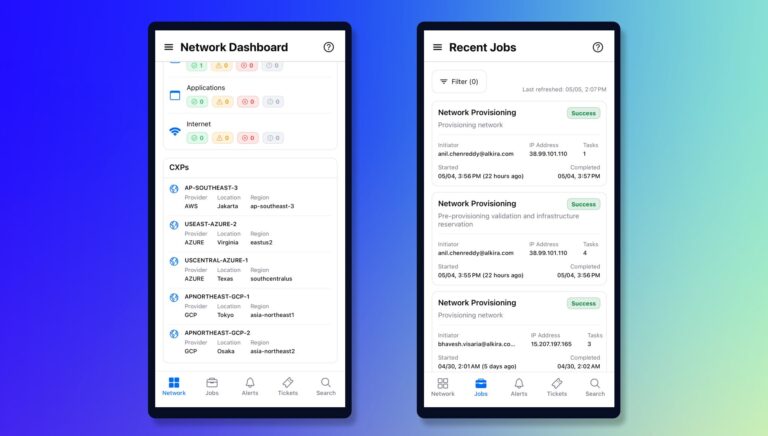
Enterprise networks are expected to run 24/7, and the teams responsible for them need visibility wherever work happens. Cloud environments, partner connections, security services, and provisioning workflows are constantly changing. When something needs attention, network and operations teams need a fast way to understand what happened, assess impact, and take the right next step. That...
Enterprises are moving quickly on AI, but many are still running networking models designed for a slower, more centralized and static era. Today’s network has to connect clouds, data centers, campuses, branches, partner environments, and increasingly private AI infrastructure while enforcing consistent policy across all of it. That creates a new operational reality: every new...
The Digital Operational Resilience Act (DORA) is reshaping how financial institutions in the European Union manage operational risk related to information and communication technology (ICT). As the regulation takes effect, organizations must ensure that their critical ICT service providers support strong operational resilience, risk management, and oversight capabilities. For technology providers supporting financial institutions, this...