What is Trusted Internet Connections (TIC) 3.0 and why is it important?
Trusted Internet Connections (TIC) 3.0 is a set of security guidelines developed by U.S. government cybersecurity organizations to ensure secure connectivity between government networks and the internet. TIC 3.0 is designed to support cloud adoption and provide secure, flexible internet connections for federal agencies, moving beyond the perimeter-based security of previous TIC versions. Learn more about TIC 3.0.
How does Alkira support secure networking for TIC 3.0?
Alkira provides a Cloud Network-as-a-Service (NaaS) platform specifically designed to meet TIC 3.0 guidelines. The platform enables secure, scalable connectivity to multiple clouds, allowing federal agencies to onboard on-premises infrastructure via AWS Direct Connect, Azure ExpressRoute, Remote VPN/ZTNA clients, and IPsec/SD-WAN connections. Alkira eliminates the need to backhaul internet traffic to on-premises for firewall inspection, providing optimal and secure paths for internet ingress and egress across multi-cloud environments. Read more.
What specific TIC 3.0 requirements does Alkira address?
Alkira addresses key TIC 3.0 requirements including Zero Trust policies for inbound and outbound traffic, device authentication, user activity management with audit logs, departmental isolation and micro-segmentation, real-time visibility into traffic flows and security rules, end-to-end encryption, and immediate threat detection with alerts and notifications.
What challenges do native cloud networking constructs present for TIC 3.0 compliance?
Native cloud constructs often lack essential features for TIC 3.0 compliance, such as effective segmentation across clouds, comprehensive encryption for all traffic, and real-time visibility into network flows. Alkira overcomes these limitations by providing unified segmentation, end-to-end encryption, and advanced visibility tools across multi-cloud and hybrid environments.
Features & Capabilities
What are the key features of Alkira's platform for secure cloud networking?
Alkira's platform offers:
Network Infrastructure-as-a-Service (NIaaS) for on-demand, hardware-free networking
Global Backbone-as-a-Service for low-latency, scalable connectivity
Integrated security with Zero Trust Network Access (ZTNA) and next-generation firewalls
Segmentation and micro-segmentation for workload isolation
Comprehensive visibility and monitoring with single-pane-of-glass tools
End-to-end encryption for all traffic
Seamless integration with leading security vendors (Check Point, Cisco, Fortinet, Palo Alto, Zscaler)
Automation support via Terraform
These features ensure secure, scalable, and efficient cloud networking for enterprises and government agencies. Learn more.
How does Alkira enable segmentation and micro-segmentation?
Alkira uses segments as isolated route domains (VRFs), allowing complete isolation of workloads or resources between business units or departments. Segments can be extended across multiple regions and inspected for traffic, supporting unique routing and policy spaces for each segment. Read more about segmentation.
What integrations does Alkira support?
Alkira integrates with a wide range of technology providers, including:
Does Alkira support automation for large-scale deployments?
Yes, Alkira supports automation through Terraform, allowing customers to provision and manage large-scale network infrastructure efficiently. This is especially valuable for organizations with complex, multi-cloud environments.
What visibility and monitoring tools does Alkira provide?
Alkira offers single-pane-of-glass visibility for monitoring, managing, and optimizing cloud networks. The platform includes real-time traffic flow analysis, security configuration discovery, threat detection, and cost optimization insights via Alkira Cloud Insights. Learn more about Cloud Insights.
How does Alkira ensure high availability and resiliency?
Alkira's infrastructure is cloud-native, leveraging redundancy across multiple availability zones and regions. This design ensures high availability, resiliency, and the ability to meet critical SLA requirements for enterprise and government customers.
What security and compliance certifications does Alkira have?
Alkira is SOC 2 and PCI-DSS compliant, demonstrating a commitment to securing customer data and maintaining robust operational controls. The platform also integrates advanced security features such as ZTNA and next-generation firewalls. See Alkira's compliance details.
Use Cases & Benefits
Who can benefit from Alkira's platform?
Alkira is designed for mid-to-large enterprises and government agencies across industries such as manufacturing, healthcare, telecommunications, financial services, biotechnology, software technology, retail, media & entertainment, and aviation. Key roles include Network Architects, Cloud Architects, Security Architects, IT Managers/Directors, CloudOps, CIOs, CTOs, and CISOs.
What business impact can customers expect from Alkira?
Customers can expect:
Up to 96% reduction in cloud setup time
47% reduction in network management time
Up to 40% lower Total Cost of Ownership (TCO) compared to traditional solutions
Enhanced security and compliance
Rapid scalability and business resilience
End-to-end visibility and control across hybrid/multi-cloud environments
What pain points does Alkira solve for its customers?
Alkira addresses:
Securing distributed workforce and applications with integrated ZTNA and firewalls
Simplifying complex multicloud and hybrid cloud networking
Providing comprehensive visibility and governance
Delivering high-performance, scalable, and reliable connectivity
These solutions are validated by customer feedback and case studies. Learn more.
How easy is it to get started with Alkira?
Customers can implement a proof of concept in as little as 4 hours and achieve full production deployment in approximately 8 weeks. Alkira's drag-and-drop interface, dedicated training platform, and 24×7 support make onboarding straightforward, even for non-technical users. Explore Alkira's training resources.
Pricing & Plans
What is Alkira's pricing model?
Alkira offers flexible pricing options:
Consumption-Based Pricing: Pay-as-you-go based on actual usage of network elements, services, and traffic.
Commitment-Based Pricing: Fixed pricing for predictable budgeting.
Pricing is determined by the quantity and size of network elements, connectors, firewalls, and data egress. Customers can view live pricing details from the portal or via APIs. See Alkira's pricing page.
Competition & Comparison
How does Alkira compare to competitors like Aviatrix, Prosimo, Nefeli, and Cato?
Alkira differentiates itself by providing:
A true abstraction layer leveraging cloud providers' infrastructure for end-to-end solutions
Single-click provisioning without requiring deep cloud expertise
Global backbone-as-a-service for multi-cloud and hybrid environments
Vendor-agnostic approach, allowing free choice of security/network stack components
Competitors often focus on orchestration overlays, application-centric networking, or SD-WAN, and may require more manual configuration or deep cloud expertise. Learn more about Alkira's differentiation.
Technical Requirements & Implementation
What are Alkira's technical requirements for deployment?
Alkira is a cloud-native platform that does not require on-premises hardware. Customers can connect via AWS Direct Connect, Azure ExpressRoute, Remote VPN/ZTNA clients, or IPsec/SD-WAN from data centers or offices. Cloud workloads (VPCs, VNETs, VCNs) connect to Alkira Cloud Exchange Points for unified management and security.
Does Alkira provide APIs for integration and cost management?
Yes, Alkira offers APIs, including billing APIs that provide real-time cloud network cost data for integration with cost management tools and dashboards. Learn more about Alkira APIs.
What technical documentation and resources are available?
Alkira provides whitepapers, solution briefs, and a dedicated wiki for in-depth technical information. Key resources include:
These resources ensure smooth onboarding and ongoing operations.
How does Alkira handle maintenance, upgrades, and troubleshooting?
Alkira provides proactive notifications for planned or emergency maintenance, a live Diagnostics Dashboard for troubleshooting, 24×7 monitoring, and dedicated support to minimize downtime and operational disruptions.
Security & Compliance
How does Alkira ensure security and compliance for government and enterprise customers?
Alkira is SOC 2 and PCI-DSS compliant, integrates advanced security features (ZTNA, next-generation firewalls), and encourages customers to follow best practices for user access and information security. See Alkira's compliance page.
Company & Recognition
What is Alkira's company background and industry recognition?
Alkira was founded by the creators of Viptela (acquired by Cisco in 2017) and is recognized for innovation in cloud networking. The company has been named a Gartner Cool Vendor, received the 2024 Excellence Award from Cloud Computing Magazine, and is listed on CRN’s 2023 Stellar Startups List. Learn more about Alkira.
What is Alkira's vision and mission?
Alkira's vision is to transform enterprise connectivity by simplifying cloud networking for the AI era. Its mission is to eliminate traditional hardware-dependent networking complexity by providing a cloud-native solution that seamlessly connects hybrid and multi-cloud environments through a unified control plane.
In today’s world, the internet has become the backbone of almost every business operation. From communication to data sharing, the internet has transformed how we work, but it has also brought significant cybersecurity challenges. As organizations continue moving their business-critical applications and data to the cloud, the need for secure and reliable connectivity has never been more critical.
To address these challenges, leading government cybersecurity organizations have come together to introduce the Trusted Internet Connections (TIC) initiative, which defines a set of security guidelines to ensure secure connectivity between government networks and the internet. The TIC program has evolved over the years. The latest version, TIC 3.0, is designed to support cloud adoption and provide a more secure and flexible internet connection to federal agencies.
In previous TIC versions, the agency traffic needed to flow through a physical TIC access point, which has proven to be an obstacle to adopting cloud-based infrastructure. For example, TIC 2.0 focused exclusively on perimeter security by channeling all incoming and outgoing agency data through a TIC access point.
Alkira, a leading provider of the multi-cloud network as a service (NaaS) solutions, has taken a proactive approach to address the security challenges of cloud connectivity. Alkira’s Cloud NaaS platform is built to meet TIC 3.0 guidelines and provides a secure and scalable way to connect to multiple clouds.
This blog will explore how Alkira’s Cloud NaaS platform can help federal agencies meet TIC 3.0 requirements and provide secure cloud connectivity.
Native Cloud Networking Design and Challenges for TIC 3.0
Federal customers who are deploying workloads in the cloud need to make sure that requirements around TIC 3.0 are taken into consideration
Zero Trust Policy for traffic inbound and outbound from the internet
Allow traffic from known devices
Ability to manage user activities using audit logs and their access to specific functions and information
Ability to isolate departments within an organization and configure specific security policies for each department
Visibility into flows and security rules
Encryption for all traffic to make sure data integrity is maintained
Any traffic threats should be detectable immediately using alerts and notifications
Figure 1: Trusted Internet Connections (TIC) 3.0 Native Approach
Native constructs of major CSPs fail to fulfill the above requirements. Here are some challenges using native constructs in CSPs:
Segmentation is impossible using the Cloud Native approach, which is essential for Government customers that need insulation between workloads or resources between different business units or departments. If workloads are deployed across multiple clouds, this becomes a bigger challenge.
Encryption is an important requirement for Government customers, but using cloud-native functionality might only be possible for some traffic. For example, private connectivity options using Cloud native constructs do not provide encryption; any encryption would come at the cost of performance.
Visibility into real-time traffic flows is limited using cloud-native functionality, meaning troubleshooting any network issues would be challenging in these environments.
Alkira Cloud Networking-as-a-Service for Trusted Internet Connections (TIC) 3.0
Alkira Cloud NaaS is the first global unified multi-cloud network delivered as-a-service. Alkira seamlessly solves the requirements for TIC 3.0 and the challenges mentioned above. Alkira allows customers to quickly onboard their on-premise infrastructure by leveraging various methods, including AWS Direct Connect, Azure Express Routes, Remote VPN/ZTNA clients, and IPsec/SD-WAN Connections from their DCs, or government offices into the Alkira Cloud Exchange Points. At the same time, customers connect their cloud workloads (VPCs, VNETs, VCNs etc.) to the Alkira Cloud Exchange Points. Alkira’s solution also allows customers to inspect the traffic between on-premise to cloud or multi-cloud environments to use a policy-driven framework to steer traffic to their desired security solutions as per the requirements. In addition, visibility into all traffic flows is available for any endpoints connected to the Alkira CXP.
Figure 2: Alkira Trusted Internet Connections (TIC) 3.0 ApproachFederal agencies can leverage any major CSPs from Azure, GCP, AWS, and OCI. The above architecture provides an optimal and secure path for Internet Ingress-Egress traffic across a multi-cloud environment; there is no need to backhaul internet traffic to on-prem for firewall inspection.
Alkira Platform Benefits
High Availability and Resiliency
Alkira’s infrastructure is built in the cloud, for the cloud. The Alkira Platform is highly resilient to leverage the full scale and flexibility of the major CSP’s. All aspects of our architecture are redundant and spread across discrete availability zones (AZ’s) and available across multiple regions to allow our customers to achieve their critical SLA requirements.
Segmentation and Micro-Segmentation
Alkira segments are completely isolated route domains or VRFs. Hence for third-party clients complete isolation of workloads can be achieved using these segments. Traffic across segments can be inspected as well. Since a segment represents a unique routing and policy space, maintaining isolation becomes seamless for customers. Based on customer requirements these segments can also be extended across multiple regions if workloads are deployed in those regions.
Alkira’s platform is highly integrated and tightly automated with vendors like Check Point, Cisco, Fortinet, Palo Alto, and ZScalar for traffic inspection for any type of traffic flow. Federal organizations get a significant advantage as they don’t have to bring up firewalls depending on traffic flow. Also, functionality like autoscaling comes as part of the solution, which helps to scale up or down depending on the requirements.
Alkira Cloud Insights helps discover all cloud resources along with their networking & security configurations, Detect threats and security vulnerabilities, Optimize and reduce your cloud spending by deleting unused resources, repurposing idle infrastructure, and maximizing efficiency across Multi-Cloud deployments. Last but not least, Alkira Cloud Insights can help Federal organizations improve the speed and responsiveness of cloud applications by fixing complex network misconfigurations.
Encryption
Alkira Cloud Network-as-a-Service platform ensures end-to-end encryption for the traffic flows within the infrastructure and gives customers control to onboard their workloads using IPSec.
Latency
Customers can connect to the Alkira Platform in the nearest region, wherever their users and workloads exist, and from their local Cloud Exchange Point (CXP), leverage the Alkira Backbone to have low latency while connecting to these applications. This can help with applications that are latency-sensitive and assist with efficient connectivity.
Automation with Terraform
Large-scale network infrastructure deployments require automation, and Alkira helps solve this, wherein the customer can use Terraform to provision the network infrastructure for Alkira.
Conclusion
The TIC 3.0 guidelines provide a framework for federal agencies to ensure secure internet connectivity. Alkira Multi-Cloud Network-as-a-Service Solution is built to meet these guidelines and provides a secure and scalable way to connect to multiple clouds. The Alkira Cloud NaaS solution provides a cloud-native architecture built on global network infrastructure, providing a comprehensive set of network services such as security, routing, load balancing, and optimization.
Alkira’s comprehensive security features, such as end-to-end segmentation, encryption, and threat detection, help protect against cyber threats and ensure the network infrastructure is secure. This solution also provides a flexible and scalable network infrastructure that can adapt to changing business needs.
Overall, Alkira is a reliable and secure platform that meets TIC 3.0 guidelines and provides a seamless way for federal agencies to connect to multiple clouds. A secure and reliable network infrastructure is crucial as organizations continue to move their critical workloads to the cloud. Alkira’s Cloud NaaS solution provides a modern approach to the network infrastructure that helps organizations manage their network infrastructure easily and securely.
Schedule a demo today to see how Alkira can help accelerate your TIC 3.0 initiatives.
Ahmed Abeer is a Sr. Product Manager at Alkira, where he is responsible for building a best-in-class Multi-Cloud Networking and Security Product. He has been in Product Management for more than ten years in different big and small organizations. He has worked with large enterprise and service provider customers to enable LTE/5G MPLS network infrastructure, automate Layer 3 Data Center, enable Next-Gen Multi-Cloud architecture, and define customers' Multi-Cloud strategies. Ahmed's technical expertise in Cloud Computing and Layer 2/Layer 3 network technologies. Ahmed is a public speaker at various conferences & forums and holds a Master's Degree in Computer Engineering.
DK
About the author
Deepesh Kumar
Deepesh Kumar is a Solutions Architect and product specialist in the computer networking industry with over 8 years of experience. He currently works as part of the post sales team at Alkira and focuses on working with customers to design and deploy the Alkira solution. Prior to working here, he worked at Viptela which was acquired by Cisco Systems. He holds a masters degree from San Jose State University.
Enterprise networks are expected to run 24/7, and the teams responsible for them need visibility wherever work happens. Cloud environments, partner connections, security services, and provisioning workflows are constantly changing. When something needs attention, network and operations teams need a fast way to understand what happened, assess impact, and take the right next step. That...
Enterprises are moving quickly on AI, but many are still running networking models designed for a slower, more centralized and static era. Today’s network has to connect clouds, data centers, campuses, branches, partner environments, and increasingly private AI infrastructure while enforcing consistent policy across all of it. That creates a new operational reality: every new...
The Digital Operational Resilience Act (DORA) is reshaping how financial institutions in the European Union manage operational risk related to information and communication technology (ICT). As the regulation takes effect, organizations must ensure that their critical ICT service providers support strong operational resilience, risk management, and oversight capabilities. For technology providers supporting financial institutions, this...




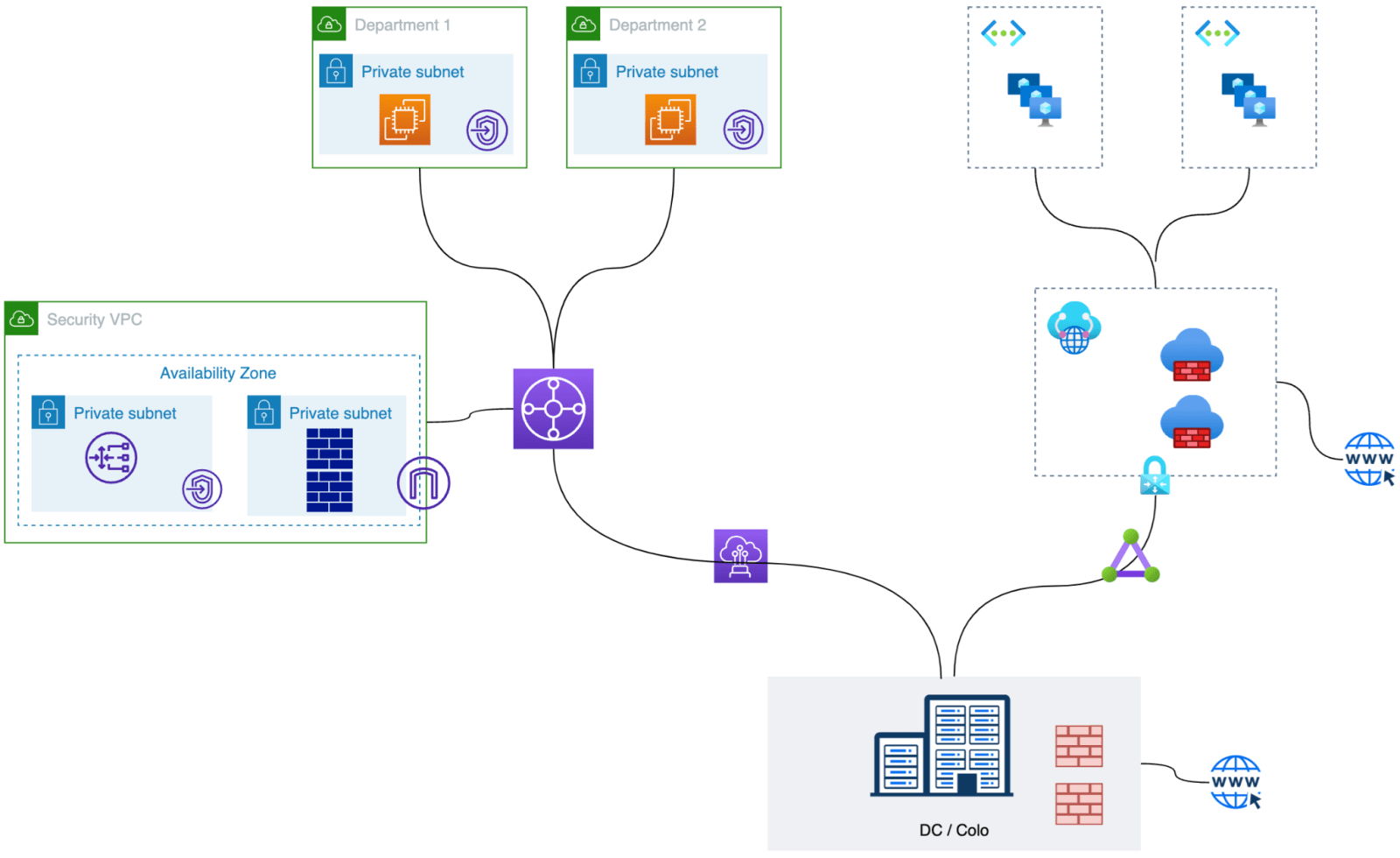 Figure 1: Trusted Internet Connections (TIC) 3.0 Native Approach
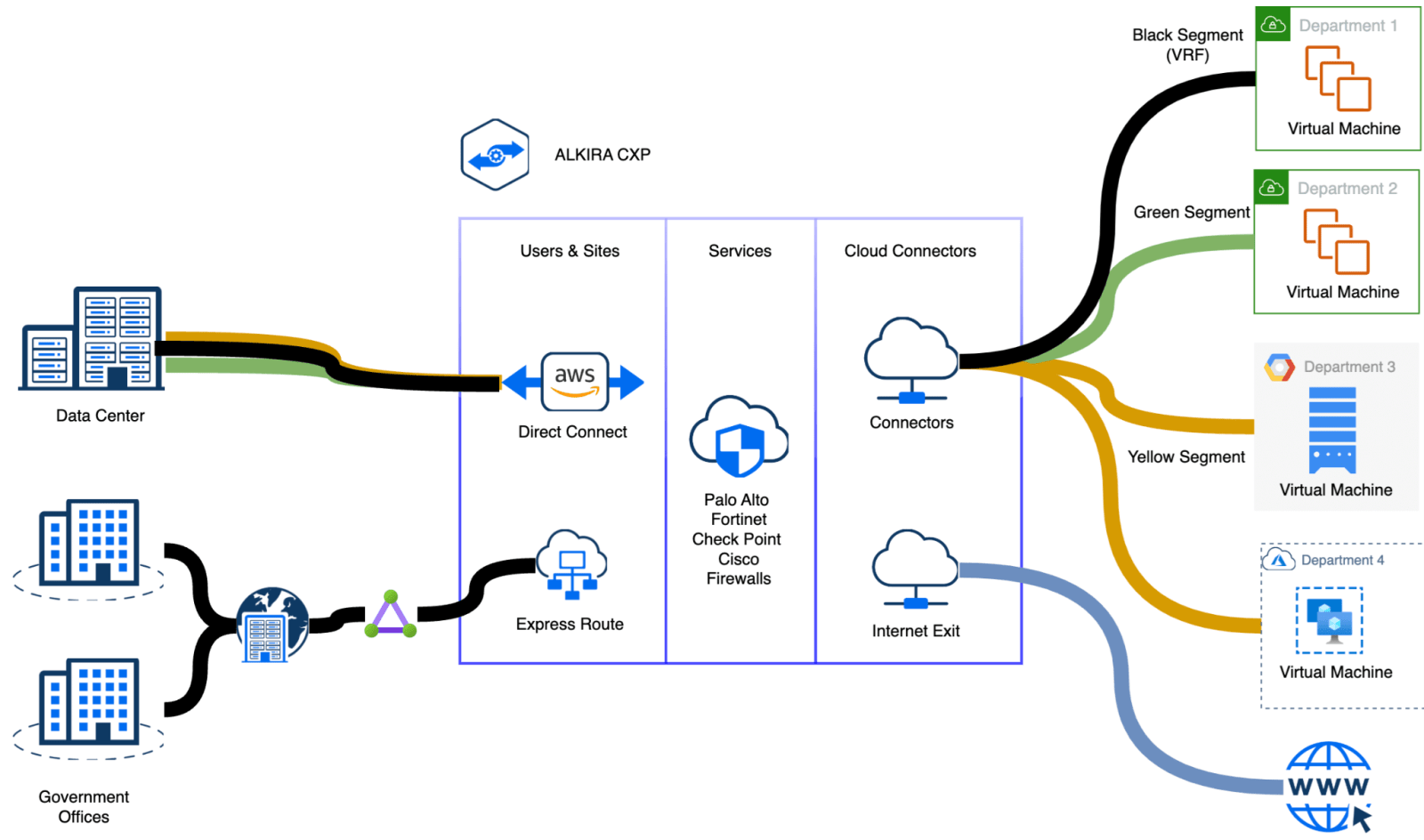 Figure 2: Alkira Trusted Internet Connections (TIC) 3.0 ApproachFederal agencies can leverage any major CSPs from Azure, GCP, AWS, and OCI. The above architecture provides an optimal and secure path for Internet Ingress-Egress traffic across a multi-cloud environment; there is no need to backhaul internet traffic to on-prem for firewall inspection.