Frequently Asked Questions
Product Integration & Features
What is the integration between Alkira and Palo Alto Networks GlobalProtect?
The integration allows customers to deploy Palo Alto Networks (PAN) GlobalProtect VPN service directly inside Alkira Cloud Exchange Points (CXPs). This enables secure remote access to applications hosted in public cloud, on-premises data centers, or the internet. Alkira automates the provisioning of infrastructure components, connectivity, lifecycle management, and operational visibility for the PAN VM series within its platform. [Source]
How does Alkira with PAN GlobalProtect improve remote user access compared to traditional data center-based solutions?
Alkira's globally distributed CXPs allow remote users to connect to the nearest point of presence, minimizing last-mile latency. This architecture avoids the need to backhaul traffic to a central data center, resulting in lower latency and improved performance for accessing cloud applications. [Source]
What segmentation capabilities does Alkira provide for remote users?
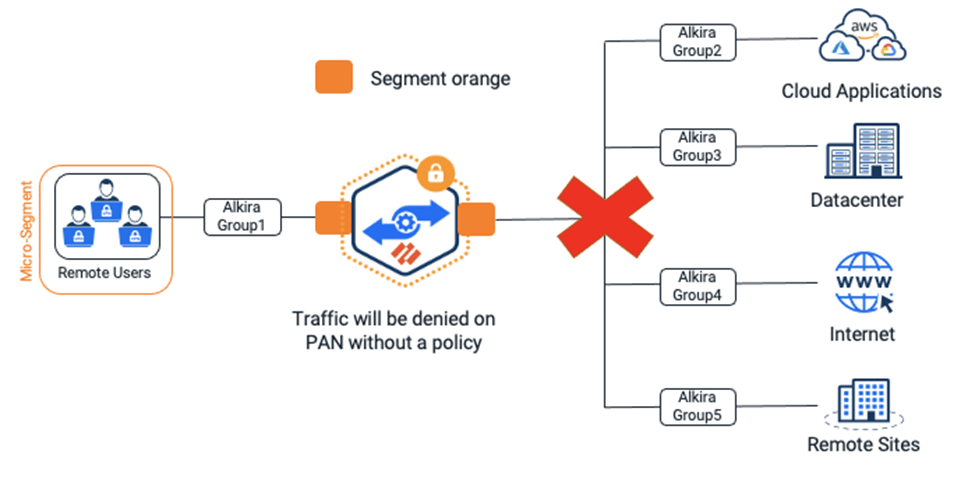
Alkira enables seamless network segmentation by allowing customers to extend their existing segments from data centers and branches into the cloud. With GlobalProtect support, different configurations can be mapped to specific segments, ensuring that remote users are securely isolated and mapped to the appropriate cloud workloads or applications. [Source]
How does Alkira support a zero trust security model for remote access?
The integration is designed for zero trust: by default, all traffic from remote users to cloud, data center, and internet is blocked unless explicitly allowed by policy. GlobalProtect users are terminated in a separate zone, and inter-zone policies must be configured to permit access, ensuring strict access control. [Source]
What operational controls do customers have over the firewall and remote access configuration?
Customers retain full control over firewall configuration, including security policies, integration with enterprise authentication infrastructure, and GlobalProtect settings. Integration with Panorama and on-demand autoscale capabilities are also supported for operational flexibility. [Source]
Business Impact & Performance
What measurable business impact can customers expect from using Alkira?
Alkira's platform delivers significant business value, including a 96% reduction in cloud setup time, a 47% reduction in network management time, and up to 40% lower total cost of ownership (TCO) compared to traditional solutions. These improvements enable faster deployment, streamlined operations, and measurable ROI. [Source]
How quickly can Alkira be implemented for secure remote access?
Customers can implement a proof of concept in as little as 4 hours, with full production deployment typically completed in about 8 weeks. The drag-and-drop interface and dedicated training resources make onboarding straightforward. [Training Platform]
How does Alkira ensure scalability and performance for remote access?
Alkira's platform automatically adjusts network infrastructure to match bandwidth demand, supporting rapid scalability and high-performance networking. The global backbone-as-a-service ensures reliable, low-latency connectivity across geographies. [Platform Details]
Security & Compliance
What security and compliance certifications does Alkira have?
Alkira is SOC 2 and PCI-DSS compliant, demonstrating its commitment to securing customer data and maintaining robust operational controls. The platform also integrates advanced security features such as Zero Trust Network Access (ZTNA) and next-generation firewalls. [Compliance Details]
How does Alkira help secure distributed workforces and applications?
Alkira integrates advanced security features like ZTNA and next-generation firewalls directly into its platform, eliminating vulnerabilities found in traditional VPNs and perimeter-based models. This ensures secure, seamless access for distributed teams and applications. [Solution Explainer]
Use Cases & Customer Success
Who can benefit from Alkira's secure remote access solution?
Alkira's solution is ideal for mid-to-large enterprises across industries such as manufacturing, healthcare, telecommunications, financial services, biotechnology, software technology, retail, media & entertainment, and aviation. It is tailored for technical roles (Network Architect, Cloud Architect, Security Architect, IT Manager/Director, CloudOps) and business leaders (VP, CTO, CIO, CISO). [Customer Stories]
Can you share examples of customers who have benefited from Alkira's secure remote access?
Yes. For example, Michaels transformed its network across 1,400 stores, ensuring secure and seamless connectivity for distributed workforces. Koch Industries simplified multicloud networking and improved agility. Warner Hotels enhanced networking efficiency and control. Chart Industries improved agility and expanded globally. SITA integrated on-premises and cloud environments for the aviation industry. [More Case Studies]
What feedback have customers given about Alkira's ease of use?
Customers have praised Alkira for dramatically reducing deployment times and simplifying complex networking tasks. For example, a network architect at a large manufacturer reported going from a 6-month DIY project to a secure, redundant solution in 3 days at low cost. Matt Hoag, CTO at Koch Industries, highlighted the ability to design and deploy networks in hours instead of months. [Testimonials]
Technical Requirements & Integrations
What integrations does Alkira support?
Alkira integrates with leading technology providers including Cisco SD-WAN, Palo Alto Networks, Fortinet NGFW, F5, Splunk, ServiceNow, Infoblox, Aruba SD-WAN, Terraform, and Itential Automation Platform. These integrations enable secure, scalable, and automated cloud networking. [Technology Partners]
Does Alkira provide APIs for integration and automation?
Yes, Alkira offers APIs, including billing APIs that provide real-time cloud network cost data for integration with cost management tools and dashboards. These APIs support automated monitoring and optimization of cloud costs. [API Details]
Where can I find technical documentation and resources for Alkira?
Alkira provides whitepapers, solution briefs, and a dedicated wiki with in-depth technical information. Key resources include the "On Demand Next-Generation Cloud Firewalls" whitepaper and detailed solution briefs. [Solution Briefs] [Wiki]
Pricing & Plans
What is Alkira's pricing model for secure remote access and cloud networking?
Alkira offers both consumption-based (pay-as-you-go) and commitment-based pricing. Costs are determined by the quantity and size of network elements (such as Alkira Cloud Exchange Points), connectors, next-generation firewalls, and data egress. Fixed hourly rates are available for specific connector types and bandwidth. Pricing details can be viewed live from the portal or via APIs. [Pricing Details]
Competition & Differentiation
How does Alkira compare to other remote access and cloud networking solutions?
Alkira differentiates itself by providing a true abstraction layer leveraging cloud providers' infrastructure, single-click provisioning, integrated security, and a global backbone-as-a-service. Unlike competitors such as Aviatrix (which focuses on orchestration overlays), Prosimo (application-centric networking), Nefeli (agent-based solutions), and Cato (SD-WAN focus), Alkira delivers end-to-end solutions for both cloud and traditional network use cases, with ease of use and vendor-agnostic flexibility. [Solution Explainer]
What are Alkira's key advantages over competitors for secure remote access?
Alkira offers integrated security (ZTNA, next-generation firewalls), rapid deployment (proof of concept in 4 hours), measurable ROI (up to 40% lower TCO), and comprehensive visibility. The platform is vendor-agnostic, supports both cloud and traditional use cases, and eliminates manual configurations through automation. [Solution Explainer]
Support & Implementation
What support and training does Alkira provide for new customers?
Alkira offers a dedicated training platform with detailed guidance, demos, and resources. Customers benefit from 24×7 monitoring, proactive notifications for maintenance, a diagnostics dashboard for troubleshooting, and dedicated support via email or support tickets. [Training Platform]
How does Alkira handle maintenance, upgrades, and troubleshooting?
Alkira provides proactive notifications for planned or emergency maintenance, a live diagnostics dashboard for troubleshooting, continuous 24×7 monitoring to meet SLA commitments, and dedicated support channels to minimize downtime and operational disruptions. [Contact Support]
Company & Vision
What is Alkira's mission and vision?
Alkira's vision is to transform enterprise connectivity by simplifying cloud networking for the AI era. Its mission is to eliminate the complexity of traditional hardware-dependent networking by providing a cloud-native solution that seamlessly connects hybrid and multi-cloud environments through a unified control plane. [Company Page]
What industry recognition has Alkira received?
Alkira has been recognized as a Gartner Cool Vendor, named among America’s Best Startup Employers by Forbes, and received the 2024 Excellence Award from Cloud Computing Magazine. It was also listed on CRN’s 2023 Stellar Startups List. [Company Page]