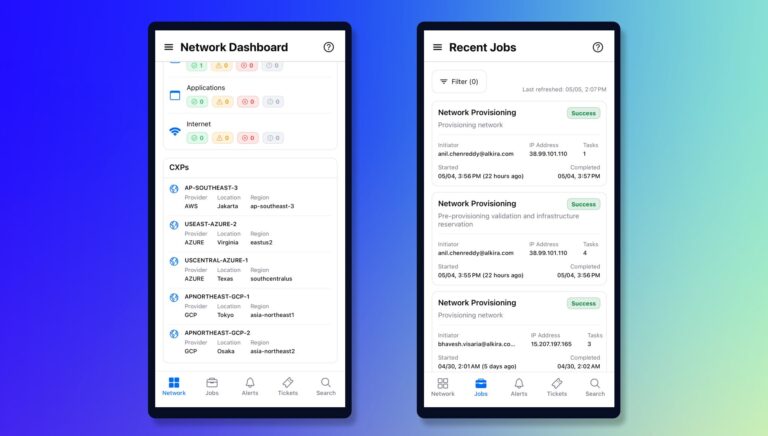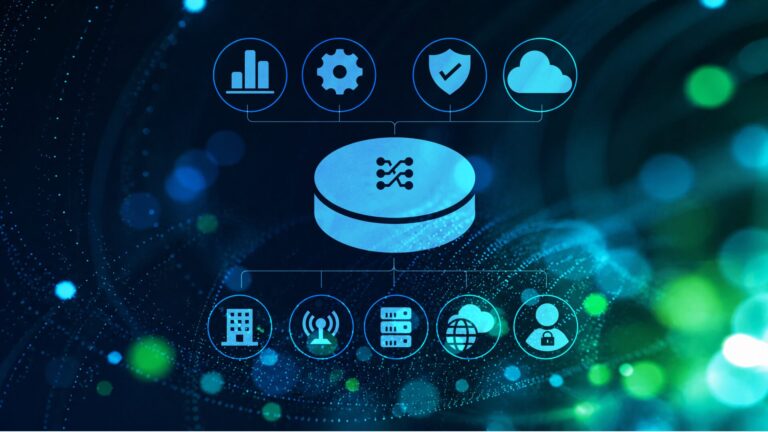


From physical networking infrastructure to a cloud operating model.
Across this series, one conclusion is clear: network modernization is no longer optional, and it is no longer only a network team concern.
Many enterprises built colo-centered architectures to accelerate early cloud adoption. In the AI and multi-cloud era, those same architectures often become the bottleneck. They slow application change, fragment security policy, and make cross-cloud operations expensive and inconsistent.
The leadership question is no longer whether to modernize. It is how deliberately and how quickly to transition to a model that can support AI-scale data movement, multi-cloud execution, and security-by-default operations.
What modernization means now
Modernization is often mistaken for an upgrade cycle: faster links, new routers, better scripts.
True modernization is an operating model shift: from building and maintaining networks as physical infrastructure to consuming network infrastructure as a service, the same way enterprises consume compute and storage in the cloud.
In practical terms, that means:
- Moving away from colo-anchored hubs as the center of gravity
- Treating multi-cloud as the default, not the exception
- Making security and segmentation intrinsic, not layered
- Designing for east-west AI traffic, not just north-south access
- Aligning network economics with usage and uncertainty
This is not a rip-and-replace exercise. It is a progressive evolution from static infrastructure to a cloud-native fabric.
Why timing matters more than ever
Three forces are converging faster than most organizations expected:
- Colo and hardware refresh cycles
Infrastructure deployed five to seven years ago is aging out. Refreshing it means committing capital and architectural rigidity, well into the AI era. - AI is moving into production
AI workloads are no longer experimental. They are entering production, stressing networks with massive data movement, low-latency requirements, and unpredictable scaling. Networks designed for predictable client-server flows get stressed quickly. - Hyper-distributed environments are the new operating reality
Multi-cloud is now table stakes, but it is not the whole story. Most enterprises are operating across clouds, data centers, SaaS, remote sites, and edge environments. At the same time, AI workloads are becoming more geographically and operationally distributed. Training may concentrate in a few locations, but inference and data capture often live closer to where events happen. That includes on-prem environments, factories, stores, clinics, vehicles, and IoT deployments.
The consequence is simple: connectivity is no longer “users to apps.” It is any-to-any communication among AI systems, data pipelines, services, and people, across public cloud and private infrastructure. The hard problem is operating this footprint with consistent segmentation, governance, and change control without creating policy drift or brittle one-off paths.
Delaying modernization does not preserve optionality. It narrows it.
The blueprint for moving forward safely
The most reliable modernization plans share the same principles. They reduce risk and are controlled while creating near-term value.
Step 1: Stand up a modern network fabric in parallel
Create a parallel operating environment that can run alongside current infrastructure. This keeps production stable while you prove operational and financial outcomes.
Step 2: Start with net-new and high-change workloads
Begin where the legacy model is most limiting:
- AI initiatives and data pipelines
- Multi-cloud applications
- New regions, new partners, new sites
- Mergers, divestitures, and fast integrations
Step 3: Migrate incrementally with rollback designed in
Move traffic in controlled phases with clear validation gates:
- Performance and reachability baselines
- Security and segmentation verification
- Failure-domain containment
- Rollback plan that is tested, not theoretical
Step 4: Let colo exit become an outcome
As dependencies move off colo-centered hubs, colos can be reduced or retired based on actual usage decline. Exit becomes a measured outcome, not a forced milestone.
Step 5: Measure success across three dimensions
Modernization should be measured beyond link metrics. Track outcomes that map to executive priorities:
Operational
- Time to implement a policy or segmentation change
- Time to connect a new cloud region, site, or partner
- Reduction in configuration drift and change backlog
Security and risk
- Consistency of segmentation across environments
- Reduction in exceptions, one-off rules, and shadow paths
- Improved auditability and policy enforcement coverage
Financial
- Avoided refresh-cycle CapEx
- Cost alignment to usage and growth uncertainty
- Reduction in operational overhead required to scale
Modernization succeeds when teams can move with confidence, not when they move recklessly fast.
What changes when the network stops being the constraint
When the network shifts to a cloud operating model, several improvements typically show up early:
- AI teams iterate faster because network provisioning and segmentation are no longer gating functions.
- Security teams gain consistency because policy intent can be enforced across environments with fewer drift points.
- Finance teams get clearer alignment between consumption and business growth, instead of fixed infrastructure bets.
- Network teams shift from maintenance to enablement by spending less time on device-level work and more time on outcomes.
- Executives regain confidence that infrastructure can scale with strategy, including AI expansion and multi-cloud execution.
The end state is not a “network project.” It is a posture where connectivity becomes reliable, governable, and easier to change.
The executive decision
This moment is not about tools or vendors. It is about posture.
Executives should ask one final question:
Is our network designed to support the business we are right now and becoming?
The answer determines whether the next refresh cycle becomes another constraint or the foundation for the next decade of growth.
Where Alkira fits: Alkira delivers Network Infrastructure as a Service designed for this transition. Enterprises use Alkira to build and operate a global, secure network fabric across clouds, data centers, and distributed locations, without owning or managing the underlying infrastructure. The model is built to reduce colo dependence, improve segmentation and governance consistency, and accelerate connectivity changes as AI and multi-cloud requirements evolve.
Read Technical Blog Part 1: “Building A New Operating Model: The Architectural Evolution of an Enterprise RAG System”
FAQs
Further reading (internal links)
“A New Operating Model” Blog Series
- Part 1: The New Network Operating Model: Modernizing Beyond Colocation Hubs
- Part 2: The New Network Operating Model: Network Infrastructure-as-a-Service
- Part 3: The New Network Operating Model: Security From Day 0
- Part 4: The New Network Operating Model: Operational Simplicity Is the Scaling Constraint
- Part 5: The New Network Operating Model: Economic Alignment for AI-Era Networking
- Part 6: The New Network Operating Model: The Modernization Strategy That Reduces Risk
- Part 7: The New Network Operating Model: Network Modernization Use Cases
- Part 8: The New Network Operating Model: Measuring Network Modernization
- Part 9: The New Network Operating Model: The Objections That Stall Modernization
- Part 10: The New Network Operating Model: The Path Forward
Technical “Building A New Operating Model” Blog SeriesTechnical Blog Part 1: “Building A New Operating Model: The Architectural Evolution of an Enterprise RAG System”

Calvin Nguyen