Alkira provides a cloud-native Network Infrastructure-as-a-Service (NIaaS) platform designed to simplify enterprise networking across hybrid and multi-cloud environments. Alkira eliminates the need for traditional hardware, offering a unified control plane for seamless, secure, and scalable connectivity. Key offerings include a global backbone-as-a-service, integrated security (such as Zero Trust Network Access and next-generation firewalls), robust RBAC, end-to-end segmentation, and comprehensive visibility tools. Learn more about Alkira's platform.
How does Alkira's Cloud Network as-a-Service (CNaaS) work?
Alkira's CNaaS consists of a unified cloud backbone with globally distributed Alkira Cloud Exchange Points (virtual points of presence). This architecture provides optimized and secure global network connectivity between clouds, branches, and end users, all delivered as a service. No customer gateway or agent installs are required, and the multi-cloud fabric can be established securely in minutes with horizontally scaled central management. Read more in the original blog.
What are Alkira's key capabilities and benefits?
Alkira's platform delivers:
Network Infrastructure-as-a-Service (NIaaS) for hybrid/multi-cloud environments
Global Backbone-as-a-Service for low-latency, scalable connectivity
Integrated security (ZTNA, next-gen firewalls)
Drag-and-drop interface for ease of use
Comprehensive visibility and single-pane-of-glass management
Up to 40% lower TCO, 96% reduction in cloud setup time, and 47% reduction in network management time
How does Alkira provide security for multi-cloud environments?
Alkira offers a unified portal to manage security across multi-cloud environments, integrating best-of-breed security vendors and supporting Infrastructure as Code (IaC) for rapid deployment. Features include Zero Trust Network Access (ZTNA), next-generation firewalls, robust RBAC, end-to-end segmentation, and context-rich policy management. These capabilities ensure secure, scalable, and segmented access to critical data and applications. Source
What is Alkira's approach to network segmentation?
Alkira enables centralized, end-to-end network segmentation across hybrid and multi-cloud environments. Each segment is a unique routing domain with independent controls and service policies, limiting the blast radius of cyberattacks, improving operational performance, reducing compliance burdens, and enhancing analytics. Segmentation can be defined without complex routing configurations. Source
How does Alkira support Infrastructure as Code (IaC)?
Alkira is a Terraform verified provider, allowing customers to manage and deploy infrastructure (VMs, networks, security components) using code. The Alkira Terraform plug-in enables deployment of segments, policies, and services, ensuring immutability and reducing exposure to vulnerabilities. Source
What integrations does Alkira support?
Alkira integrates with leading technology providers, including:
Yes, Alkira offers APIs, including billing APIs that provide real-time cloud network cost data for integration with cost management tools and dashboards. These APIs support automated monitoring and optimization of cloud costs. Learn more.
How does Alkira ensure visibility and governance?
Alkira provides a single-pane-of-glass portal with exhaustive network and application-level statistics for hybrid and multi-cloud environments. This enables businesses to monitor, manage, and optimize their networks, quickly identify risks, and enforce compliance policies. Source
What security and compliance certifications does Alkira have?
Alkira is SOC 2 and PCI-DSS compliant, demonstrating its commitment to securing customer data and maintaining robust operational controls. The platform also integrates advanced security features such as ZTNA and next-generation firewalls. See Alkira's Compliance Page.
Pain Points & Solutions
What problems does Alkira solve for enterprises?
Alkira addresses:
Operational complexity in cloud networking
Security vulnerabilities in traditional VPNs and perimeter-based models
Complexity of multi-cloud and hybrid cloud networking
Lack of comprehensive visibility and governance
Scalability and performance limitations of legacy solutions
Alkira's platform simplifies networking, enhances security, and provides measurable ROI. Learn more.
How does Alkira help secure distributed workforces and applications?
Alkira integrates Zero Trust Network Access (ZTNA) and next-generation firewalls directly into its platform, eliminating vulnerabilities in traditional VPNs and ensuring secure, seamless access for distributed teams and applications. Learn more about ZTNA.
How does Alkira address the complexity of multi-cloud and hybrid cloud networking?
Alkira's global backbone-as-a-service and true abstraction layer eliminate intricate configurations and manual setups, reducing deployment times from months to minutes and enabling rapid scalability. Learn more.
How does Alkira provide comprehensive visibility and governance?
Alkira offers a unified portal for monitoring, managing, and optimizing cloud networks, ensuring businesses maintain control and transparency. This addresses challenges related to fragmented tools and inefficiencies. Source
How does Alkira deliver high-performance networking?
Alkira's platform automatically adjusts network infrastructure to match bandwidth demand, ensuring scalable, reliable, and low-latency connectivity for cloud and AI workloads. Learn more.
Use Cases & Customer Success
Who can benefit from Alkira's solutions?
Alkira is designed for mid-to-large enterprises across industries such as manufacturing, healthcare, retail, telecommunications, financial services, biotechnology, software technology, media & entertainment, and aviation. Target roles include Network Architects, Cloud Architects, Security Architects, IT Managers/Directors, CloudOps, CIOs, CTOs, and CISOs. See customer stories.
Can you share specific case studies or customer success stories?
Yes, notable examples include:
Michaels: Transformed its network across 1,400 stores in record time. Read the case study
Koch Industries: Simplified multicloud networking and improved agility. Watch the video
Warner Hotels: Enhanced networking efficiency and B2B connectivity. Watch the video
Chart Industries: Improved agility, saved costs, and expanded globally. Watch the video
SITA: Integrated on-premises and cloud environments for aviation. Watch the video
What industries are represented in Alkira's case studies?
Industries include manufacturing, retail, healthcare, telecommunications, financial services, biotechnology/life sciences, software technology, media & entertainment, and aviation. See all case studies.
How easy is it to get started with Alkira?
Customers can implement a proof of concept in as little as 4 hours, with full production deployment typically taking about 8 weeks. Alkira provides a drag-and-drop interface, a dedicated training platform (Alkira Training Platform), 24×7 monitoring, and dedicated support to ensure a smooth onboarding process.
What feedback have customers given about Alkira's ease of use?
Customers consistently praise Alkira for its simplicity and speed. For example, a Network Architect at a large manufacturer said, "The IT DIY approach was going to take 6 months to be secure and redundant and all. Alkira did it for us in 3 days, and at very low cost." Matt Hoag, CTO at Koch Industries, noted, "We had gone from a mass of complexity and months of work to a dashboard that allowed us simply to draw our network and deploy it in a few hours." See more testimonials.
What business impact can customers expect from Alkira?
Customers can expect:
96% reduction in cloud setup time
47% reduction in network management time
Up to 40% lower TCO compared to traditional solutions
Enhanced security, scalability, and business resilience
Support for digital transformation and end-to-end visibility
These outcomes are supported by customer case studies and measurable ROI. Learn more.
How does Alkira help with Multi-Cloud Extranet and uniform security?
How can Alkira help reduce staff time for cloud security?
Alkira's platform can help organizations achieve up to 80% less staff time spent on cloud security by automating and centralizing security management. For more details, watch the Achieving 80% Less Staff Time for Cloud Security video.
Pricing & Plans
What is Alkira's pricing model?
Alkira offers flexible pricing, including:
Consumption-based (pay-as-you-go) pricing based on usage of provisioned elements (sites, cloud instances, network services, traffic)
Commitment-based (fixed) pricing for predictable budgeting
Pricing is determined by the quantity and size of network elements, connectors, firewalls, and data egress. Customers can view live pricing details from the portal or via APIs. See Alkira's Pricing Page.
Competition & Comparison
How does Alkira compare to Aviatrix?
Aviatrix focuses on orchestration overlays and requires deep cloud expertise for deployment. Alkira provides a true abstraction layer leveraging cloud providers' infrastructure, offers single-click provisioning without deep expertise, and delivers end-to-end solutions for both cloud and traditional network use cases. Learn more.
How does Alkira compare to Prosimo?
Prosimo is application-centric and limited in addressing traditional network use cases. Alkira provides full-stack networking and security, addresses both cloud and traditional use cases, and offers scalable networks. Learn more.
How does Alkira compare to Nefeli?
Nefeli uses agent-based solutions and requires manual configurations. Alkira eliminates manual configurations with automated routing, provides enterprise-grade connectivity, and delivers a unified NIaaS platform. Learn more.
How does Alkira compare to Cato?
Cato focuses on SD-WAN and is limited in multi-cloud and hybrid environments. Alkira provides a global backbone-as-a-service for multi-cloud/hybrid environments and offers integrated security features like ZTNA. Learn more.
Technical Requirements & Documentation
What technical documentation and resources are available for Alkira?
These resources offer in-depth technical insights and guidance.
What are Alkira's technical requirements for deployment?
Alkira's platform is cloud-native and does not require customer gateway or agent installs. Deployment is managed centrally and can be established in minutes. Infrastructure as Code is supported via Terraform. Source
These resources ensure customers can adopt Alkira's solutions efficiently.
How does Alkira handle maintenance, upgrades, and troubleshooting?
Alkira provides proactive notifications for maintenance, a Diagnostics Dashboard for troubleshooting, 24×7 monitoring, and dedicated support to minimize downtime and operational disruptions.
Company & Vision
What is Alkira's vision and mission?
Alkira's vision is to transform enterprise connectivity by simplifying cloud networking for the AI era. Its mission is to eliminate the complexity of traditional hardware-dependent networking by providing a cloud-native solution that seamlessly connects hybrid and multi-cloud environments through a unified control plane. Learn more about Alkira.
What is Alkira's company background and industry recognition?
Alkira was founded by the creators of Viptela (acquired by Cisco in 2017) and has been recognized as a Gartner Cool Vendor, a Forbes Best Startup Employer, and a recipient of the 2024 Excellence Award from Cloud Computing Magazine. See company details.
The benefits of cloud are real and tangible, and enterprises and even governments are now accustomed to hosting mission-critical workloads in the cloud, often with multiple cloud providers. For digital transformation to be truly successful, cloud resources must be secure, scalable, and segmented so that critical data is made available only to trusted entities. In this blog, we will detail some best practices for multi-cloud security and how Alkira’s Cloud Network as-a-Service platform can help you in the journey.
The demand to accelerate digital innovation is driving organizations to build applications in the cloud using agile practices and cloud-native architectures like containers and microservices. These containers get spun up and down dynamically within seconds, and applications that run on these microservices have dependencies that can span multiple clouds and geographies. The leading cloud providers provide a foundational baseline of security for the core cloud infrastructure (the underlying network, hypervisor hosting these workloads etc), but the responsibility of safeguarding data and securing connectivity from edge to core to cloud still falls on the customer’s lap and can be an enormously complex challenge.
To protect today’s cloud and multi-cloud network workloads, traditional on-premises security models simply won’t work. They cater well to static environments and lifting and shifting these controls to the cloud leads to additional operational and management complexities. Plus, backhauling cloud traffic back to the datacenter or to a different cloud for applying security policies is not a viable option, as such inefficiencies lead to increased latency and degraded application performance.
Applying cloud-native security constructs is not trivial either. Different cloud providers have different implementations, understanding every provider’s security knob and using them to enforce consistent security policies from different dashboards is a very time consuming and error prone process. Also the cloud-native solutions lack the feature sets of established security vendors, advanced detection and mitigation of cyber threats may not be possible always using these solutions alone.
The ideal solution is to have a single portal that manages the security of the multi-cloud environment using best of breed security vendors. Coupled with support for “Infrastructure as Code”, these security services can be deployed and validated using CI/CD pipelines within minutes for immediate results. The Alkira solution offers exactly this and much more.
Alkira Provides Security for the Cloud Era
The Alkira Cloud Network as-a-Service (CNaaS) solution consists of a unified cloud backbone with globally distributed Alkira Cloud Exchange Points (virtual points of presence) that provide optimized and secure global network connectivity between clouds, branches, and end users, all delivered as a service. With no customer gateway or agent installs, and with a horizontally scaled central management, the multi-cloud fabric can be established seamlessly and securely in minutes.
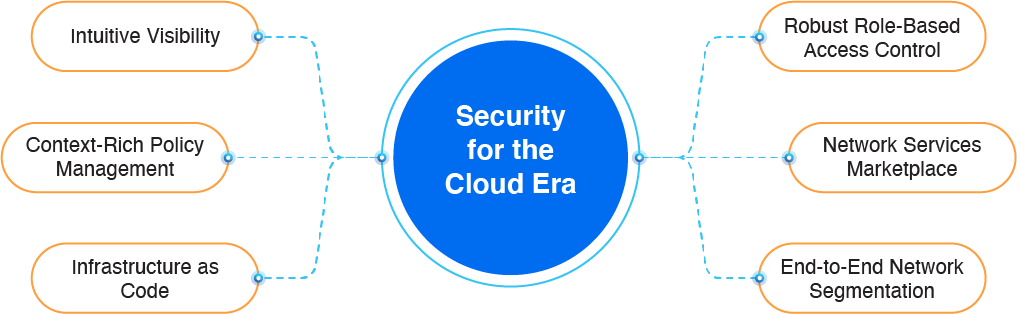
Figure: Network Security Meets Cloud
Robust RBAC
Alkira’s unique platform gives IT leaders complete control over a flexible set of robust RBAC tools. Onboarding is secure and prevents unauthorized access, with IP specific authentication, as well as options for SSO and two-factor authentication. From there, several permission roles are available, ranging from full admin control to simple read-only access. Alkira even allows for the creation of customized roles, giving customers complete control over their environment with the ability to tailor accounts to specific needs. Alkira backs all this with detailed logs and access reports, giving customers instant access to auditable data to track any fraudulent activity or misuse.
Network Services Marketplace
Many enterprises have already done their due diligence and have an on-premises security partner of choice, ideally, they prefer to use the same vendor for their cloud security needs as well. At Alkira, we recognize this and have a wide choice of third-party security providers to choose from. The preferred service is intelligently inserted and integrated into the cloud environment without additional routing controls. Alkira also manages the entire lifecycle of this security instance, and to retain existing ROIs, the security instance can be spun up using existing licenses or spun up using a pay-as-you-go model. As customer business volume evolves, these instances scale up or down based on real time capacity demand. With intelligent traffic steering, Alkira maintains bidirectional flow symmetry to these stateful firewalls, this ensures that firewall elasticity does not introduce any packet loss in the network.
End-to-End Network Segmentation
Network segmentation is a mechanism in which a network is partitioned into multiple distinct subnetworks, route controls and security policies can each be applied to these compartments separately. Segmentation offers the following key benefits:
Limits cyber attack blast radius, hacks and breaches get limited to the affected segment.
Improve operational performance, for example issues in the test segment will have no impact on the production environment.
Reduce compliance burden, e.g. by confining payment processing systems to one segment limits complex and costly audit processes to that segment alone.
Better analytics around network monitoring and network access.
Existing cloud-native constructs have very little or no support for segmentation, marrying these already complex constructs with on-premises and remote user segments causes end-to-end segmentation chaos. But with the Alkira solution, network segments can be centrally defined and carved out for any diverse hybrid cloud or multi-cloud environments without complex routing configurations. Each segment is a unique routing domain, where controls and service policies can be applied independently thereby realizing the full benefits of segmentation mentioned above.
Intuitive Visibility
You can’t secure what you can’t see is now a foregone conclusion. To truly understand your cloud security posture, you need to get complete and intuitive visibility into your network. The Alkira portal provides exhaustive network and application-level stats for your hybrid cloud and multi-cloud environments, illuminating all hot and blind spots. For example, if a data source or an application is not known, appropriate security and compliance policies can be swiftly put in place to minimize risks and disruptions.
Context-Rich Policy Management
As seen before, Alkira extends segmentation seamlessly to hybrid cloud and multi-cloud environments, these segments can be further micro-segmented into policy domains. This is achieved by clubbing together remote users, on-premises sites or cloud workloads end points (connectors) into a compartment (group). Once a group is created, context-rich policies can be applied to them to easily enforce the business intent. Here are couple of examples:
VPC group can access Internet applications only over port 443 after traversing a firewall
Web group G1 has access to Application group G2, but not to Data group G3.
Any number of groups can be created, traffic policies can be easily enforced (allow/permit/firewall inspect) based on 6-tuple or application-based identification.
Infrastructure as Code
Infrastructure as Code (IaC) is the management and deployment of infrastructure (VMs, networks, security components) using code. Typically done using HashiCorp’s Terraform, the infrastructure environment is defined using simple human readable files (either in json or cfg files). Terraform ensures the environment’s sanctity, and the state always remains the same without any drift. From a security perspective, this is very critical as security policies are now immutable and the system is not exposed to inadvertent vulnerabilities. Alkira is a Terraform verified provider, the entire security posture (segments, policies, services and more) can be deployed using Alkira’s Terraform plug-in with ease.
Conclusion
Simplicity and security didn’t coexist so far, but Alkira’s CNaaS solution is changing that now. By offering best-of-breed security with segmentation, micro-segmentation and IaC, all delivered as a service, your multi-cloud experience is in good hands with Alkira.
Bharath is a seasoned campaigner in the computer networking industry. Currently, he is a lead engineer at Alkira and is responsible for designing & developing the Alkira test automation framework & infrastructure. Prior to Alkira, he held several lead engineering positions in Cloudgenix (SD-WAN App Fabric), Nuage Networks (SDN), Juniper & Cisco (Data Center and Storage). In his spare time, he enjoys reading, exploring Bay Area trails and playing tennis. He holds a Bachelors Degree from University of Madras, India and a Masters Degree from University of Illinois, Chicago. His twitter handle is @bchakrav.
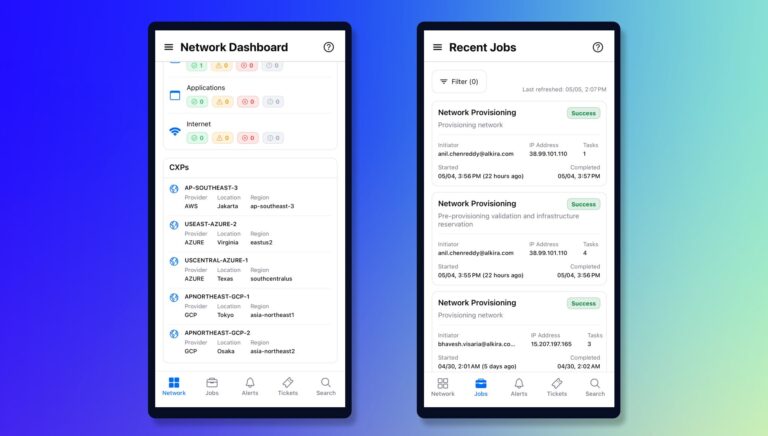
Enterprise networks are expected to run 24/7, and the teams responsible for them need visibility wherever work happens. Cloud environments, partner connections, security services, and provisioning workflows are constantly changing. When something needs attention, network and operations teams need a fast way to understand what happened, assess impact, and take the right next step. That...
Enterprises are moving quickly on AI, but many are still running networking models designed for a slower, more centralized and static era. Today’s network has to connect clouds, data centers, campuses, branches, partner environments, and increasingly private AI infrastructure while enforcing consistent policy across all of it. That creates a new operational reality: every new...
The Digital Operational Resilience Act (DORA) is reshaping how financial institutions in the European Union manage operational risk related to information and communication technology (ICT). As the regulation takes effect, organizations must ensure that their critical ICT service providers support strong operational resilience, risk management, and oversight capabilities. For technology providers supporting financial institutions, this...