What is Alkira's Network Infrastructure-as-a-Service (NIaaS)?
Alkira's Network Infrastructure-as-a-Service (NIaaS) is a cloud-native platform that provides on-demand, scalable, and secure networking infrastructure for enterprises. It eliminates the need for traditional hardware, enabling seamless connectivity across hybrid and multi-cloud environments. The platform features a drag-and-drop interface and supports Infrastructure-as-Code (IaC) automation, allowing rapid deployment and management of complex networks in minutes. Learn more.
How does Alkira support AI/ML workloads in the cloud?
Alkira accelerates AI/ML project delivery by providing a global backbone-as-a-service for ultra-low latency, high-throughput connectivity. This is ideal for real-time AI/ML workloads, enabling secure, policy-driven resource sharing and comprehensive visibility for monitoring and optimizing AI/ML pipelines. Read more.
What are the key capabilities and benefits of Alkira's platform?
Key capabilities include:
Network Infrastructure-as-a-Service (NIaaS) for hybrid/multicloud environments
Global Backbone-as-a-Service for scalable, low-latency connectivity
Up to 40% lower TCO, 96% faster cloud setup, and 47% less network management time
These features help enterprises simplify cloud networking and accelerate digital transformation. Platform details.
What types of integrations does Alkira support?
Alkira integrates with leading technology providers and platforms, including Cisco SD-WAN, Palo Alto Networks, Fortinet NGFW, F5, Splunk, ServiceNow, Infoblox, Aruba SD-WAN, Terraform, and Itential Automation Platform. These integrations enable secure, scalable, and automated network operations. See all partners.
Does Alkira offer APIs for integration and automation?
Yes, Alkira provides APIs, including billing APIs that deliver real-time cloud network cost data. These APIs can be integrated with cost management tools and dashboards, supporting automated monitoring and optimization of cloud costs. API details.
Where can I find technical documentation and resources for Alkira?
What measurable performance improvements does Alkira deliver?
Alkira reduces cloud setup time by 96%, network management time by 47%, and achieves 70% faster mean-time-to-resolution (MTTR) for complex issues. These improvements translate into faster deployment, streamlined operations, and measurable ROI. Learn more.
How does Alkira ensure security and compliance for sensitive data?
Alkira is SOC 2 and PCI-DSS compliant, providing integrated security features such as Zero Trust Network Access (ZTNA) and next-generation firewalls. These controls protect sensitive data across clouds and on-premises, supporting regulated industries like financial services and healthcare. Compliance details.
How does Alkira provide visibility and monitoring for cloud networks?
Alkira offers a single-pane-of-glass dashboard for real-time monitoring, route visualization, and actionable alerts. This enables proactive issue resolution and optimization of network performance for AI/ML and enterprise workloads.
Does Alkira support network segmentation and resource sharing?
Yes, Alkira enables centralized network segmentation, allowing organizations to compartmentalize networks for compliance and governance. Policy-driven resource sharing allows secure access to data across segments, supporting AI/ML model training and inference. Network segmentation details.
How does Alkira handle high-performance, low-latency connectivity?
Alkira's global backbone-as-a-service delivers ultra-high speed, low-latency connectivity. Customers connect to the nearest Alkira Cloud Exchange Point, ensuring efficient, real-time data transfer for AI/ML and business-critical applications.
What automation and Infrastructure-as-Code (IaC) capabilities does Alkira offer?
Alkira supports IaC automation, including integration with Terraform and CI/CD pipelines. This enables automated deployment, retraining, and monitoring of AI/ML models, as well as streamlined network management.
Pricing & Plans
What is Alkira's pricing model and how is it determined?
Alkira offers flexible pricing models, including consumption-based (pay-as-you-go) and commitment-based options. Pricing is determined by the quantity and size of network elements (e.g., Cloud Exchange Points), connectors, next-generation firewalls, and data egress. Fixed hourly rates are available for specific connector types and bandwidth. Customers can view live pricing in the portal or via APIs. Pricing details.
Use Cases & Benefits
What business impact can customers expect from using Alkira?
Customers can expect:
Operational efficiency: 96% reduction in cloud setup time, 47% less network management time
Cost savings: Up to 40% lower TCO compared to traditional solutions
Enhanced security and compliance for distributed workforces and sensitive data
Scalability and business resilience for dynamic environments
End-to-end visibility and control across hybrid/multi-cloud networks
These benefits are validated by customer testimonials and case studies. More info.
What are some real-world use cases for Alkira in AI/ML and enterprise networking?
Alkira supports use cases such as:
Financial Services: Secure, PCI-DSS-compliant connectivity for fraud detection models
Healthcare: HIPAA-compliant, real-time analytics for patient data
Retail & Manufacturing: Aggregation of IoT and sales data for predictive analytics
MLOps: Integration with CI/CD pipelines for automated model deployment and monitoring
Alkira is designed for technical and business leaders at mid-to-large enterprises, including Network, Cloud, and Security Architects, IT Managers/Directors, CloudOps, and executive roles such as VP, CTO, CIO, and CISO. Industries served include manufacturing, healthcare, telecommunications, financial services, biotechnology, software technology, retail, media & entertainment, and aviation. See customer stories.
What customer feedback has Alkira received regarding ease of use?
Customers consistently praise Alkira for its intuitive drag-and-drop interface, rapid deployment, and comprehensive visibility. For example, a Network Architect at a large manufacturer reported, "The IT DIY approach was going to take 6 months to be secure and redundant and all. Alkira did it for us in 3 days, and at very low cost." Read more testimonials.
Can you share specific case studies or customer success stories?
Yes. Notable case studies include:
Michaels: Transformed its network across 1,400 stores in record time. Read case study
Koch Industries: Simplified multicloud networking and improved agility. Watch video
Warner Hotels: Enhanced networking efficiency and B2B connectivity. Watch video
Chart Industries: Improved agility, saved costs, and expanded globally. Watch video
SITA: Integrated on-premises and cloud environments for aviation. Watch video
What core problems does Alkira solve for enterprises?
Alkira addresses:
Operational complexity in cloud networking
Security vulnerabilities in traditional VPNs and perimeter models
Complexity of multicloud and hybrid cloud networking
Lack of scalability and visibility in legacy solutions
Alkira's platform simplifies networking, integrates advanced security, and provides comprehensive visibility and scalability. Solution explainer.
How does Alkira solve the challenge of securing distributed workforces and applications?
Alkira integrates Zero Trust Network Access (ZTNA) and next-generation firewalls directly into its platform, eliminating vulnerabilities in traditional VPNs and ensuring secure, seamless access for distributed teams and applications.
How does Alkira address complexity in multicloud and hybrid cloud networking?
Alkira's true abstraction layer and global backbone-as-a-service eliminate manual configurations and complex setups, reducing deployment times from months to minutes and enabling seamless connectivity across clouds, data centers, and users.
How does Alkira provide comprehensive visibility and governance?
Alkira offers a single-pane-of-glass dashboard for monitoring, managing, and optimizing cloud networks, ensuring businesses maintain control and transparency across their entire infrastructure.
How does Alkira ensure high-performance networking for demanding workloads?
Alkira's global backbone-as-a-service delivers scalable, reliable, and low-latency connectivity, supporting real-time analytics and AI/ML workloads without the need to replicate models across regions.
Competition & Comparison
How does Alkira compare to Aviatrix?
Aviatrix focuses on orchestration overlays and requires deep cloud expertise for deployment. Alkira provides a true abstraction layer leveraging cloud providers' infrastructure, offers single-click provisioning without deep expertise, and delivers end-to-end solutions for both cloud and traditional network use cases.
How does Alkira compare to Prosimo?
Prosimo is application-centric and limited in addressing traditional network use cases. Alkira provides full-stack networking and security, addresses both cloud and traditional use cases, and offers scalable networks for diverse enterprise needs.
How does Alkira compare to Nefeli?
Nefeli uses agent-based solutions and requires manual configurations. Alkira eliminates manual configurations with automated routing, provides enterprise-grade connectivity for cloud and AI-based applications, and delivers a unified platform for network infrastructure as-a-service.
How does Alkira compare to Cato?
Cato focuses on SD-WAN and is limited in multi-cloud and hybrid environments. Alkira provides a global backbone-as-a-service for multi-cloud and hybrid environments, integrated security features like ZTNA, and supports seamless connectivity for distributed workforces and applications.
Why should a customer choose Alkira over alternatives?
Alkira offers a true abstraction layer, integrated security, ease of use, rapid global deployment, measurable ROI, vendor-agnostic architecture, and comprehensive visibility. These features differentiate Alkira from competitors and make it a leader in simplifying multicloud networking. Learn more.
Implementation, Support & Training
How long does it take to implement Alkira, and how easy is it to get started?
Customers can implement a proof of concept in as little as 4 hours, with full production deployment typically taking about 8 weeks. Alkira's drag-and-drop interface and dedicated training platform make onboarding straightforward, even for non-technical users. Training platform.
What training and technical support does Alkira provide?
Alkira offers a dedicated training platform with guidance, demos, and resources, 24×7 monitoring, and dedicated support via email or support tickets. Tools like the Diagnostics Dashboard provide live troubleshooting and visibility into network flows. Training details.
What customer service and support are available after purchase?
Alkira provides proactive notifications for maintenance, a diagnostics dashboard for troubleshooting, 24×7 monitoring, and dedicated support via support@alkira.com or support tickets. These services ensure smooth operations and rapid issue resolution.
How does Alkira handle maintenance, upgrades, and troubleshooting?
Alkira informs customers in advance of maintenance, provides a diagnostics dashboard for live troubleshooting, offers 24×7 monitoring, and delivers dedicated support to minimize downtime and operational disruptions.
Security & Compliance
What security and compliance certifications does Alkira have?
Alkira is SOC 2 and PCI-DSS compliant, ensuring high standards for security, availability, and confidentiality. These certifications demonstrate Alkira's commitment to protecting customer data and supporting regulated industries. Compliance details.
What security features are integrated into Alkira's platform?
Alkira integrates Zero Trust Network Access (ZTNA), next-generation firewalls, and policy-driven controls directly into its platform, providing secure connectivity for distributed workforces and applications.
Industries & Case Studies
Which industries are represented in Alkira's case studies?
Industries include manufacturing (e.g., Chart Industries), retail (Michaels), healthcare, telecommunications, financial services, biotechnology/life sciences, software technology, media & entertainment (Warner Hotels), and aviation (SITA). See all case studies.
Company & Vision
What is Alkira's vision and mission?
Alkira's vision is to transform enterprise connectivity by simplifying cloud networking for the AI era. Its mission is to eliminate the complexity of traditional networking by providing a cloud-native solution that seamlessly connects hybrid and multi-cloud environments through a unified control plane. Company details.
What is Alkira's company background and industry recognition?
Alkira was founded by the creators of Viptela (acquired by Cisco in 2017) and has been recognized as a Gartner Cool Vendor, a Forbes Best Startup Employer, and a recipient of the 2024 Excellence Award from Cloud Computing Magazine. More about Alkira.
Who are some of Alkira's customers?
Alkira serves Fortune 100 enterprises, leading system integrators, and global managed service providers. Notable customers include Michaels, Koch Industries, Warner Hotels, and SITA. Customer stories.
Alkira Network: Cloud-Network Convergence
What are the benefits of Alkira's cloud and AI-enabled network infrastructure?
Alkira's cloud and AI-enabled network infrastructure unifies clouds, sites, and users with on-demand scalability, streamlined operations, and unified networking across diverse environments. Watch the Alkira Network: Cloud-Network Convergence video.
Intelligent Clouds with Alkira Network Infrastructure-as-a-Service
Summarize with AI
Artificial Intelligence and Machine Learning (AI/ML) have arrived in a big way. What was once considered a strict academic pursuit (0$ spend in 2013) is now a critical component of business strategy across several industries (more than $50B spend in 2020).
One significant contributing factor to AI adoption is the cloud. With easy to use tools and frameworks, the cloud offers data and compute intensive services at a massive scale yet at an affordable price.
But developing and deploying AI/ML models in the cloud is not always smooth sailing, in this blog we will talk about what holds enterprises back from realizing their AI potential and how Alkira’s solution and technology helps them overcome some of these barriers.
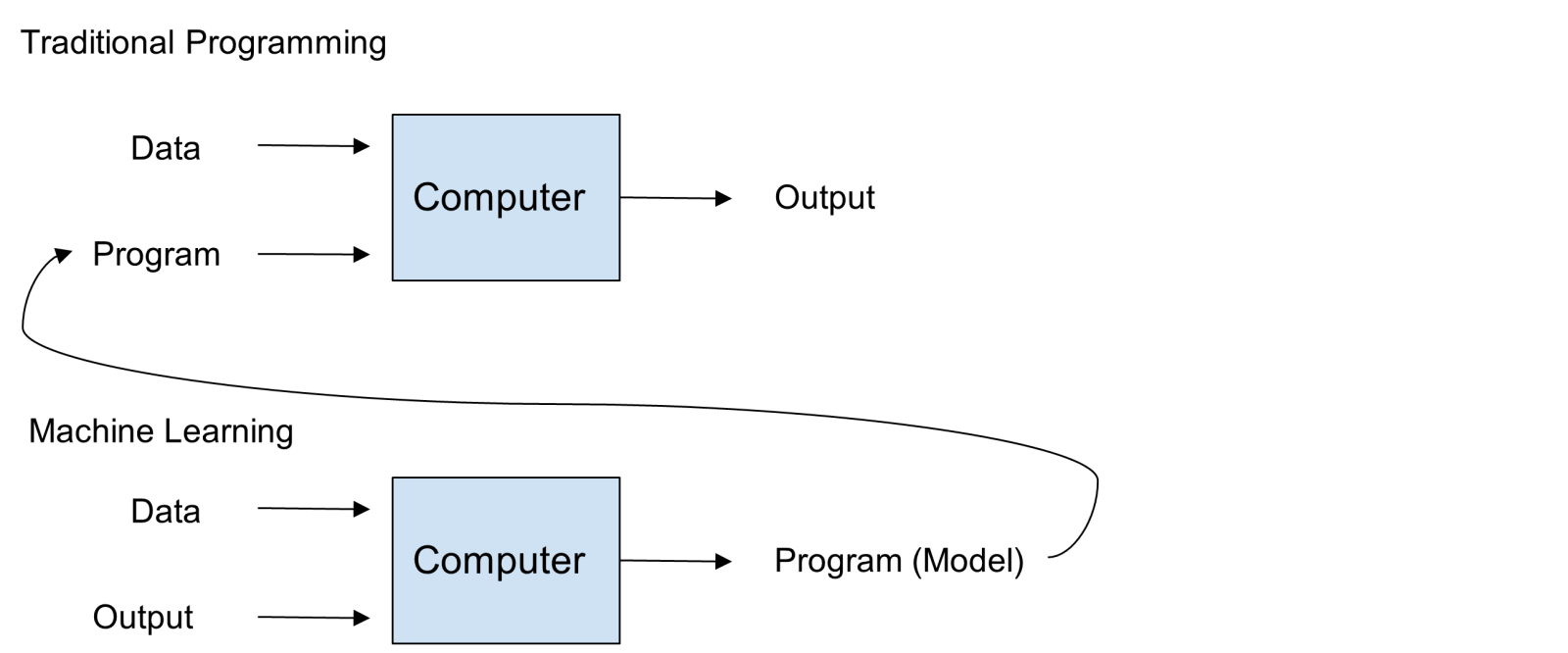
Machine learning (sub-domain of AI) is when computer models learn and discern patterns, trends and correlations in data without explicit programming.
Traditional programming takes well defined inputs, processes them on predefined requirements and produces a desired output. Machine learning on the other hand takes well defined inputs and outputs, uses algorithms (linear regressions, neural networks etc) to self create programs (or models) and deduce output for any new inputs (as shown in the loop above).
Input data is often very large, structured or unstructured and comes in various shapes and forms. Examples include media (digital photos, audio, video), documents (spreadsheets, log files, emails), mobile communications (instant messaging, chats, collaboration software) and IoT(sensor, ticker). The models look deep into these disparate datasets and provide predictive and prescriptive insights that humans typically can’t do. This unlocks a plethora of use cases like fraud detection, customized recommendations, healthcare analysis, asset optimization and much more.
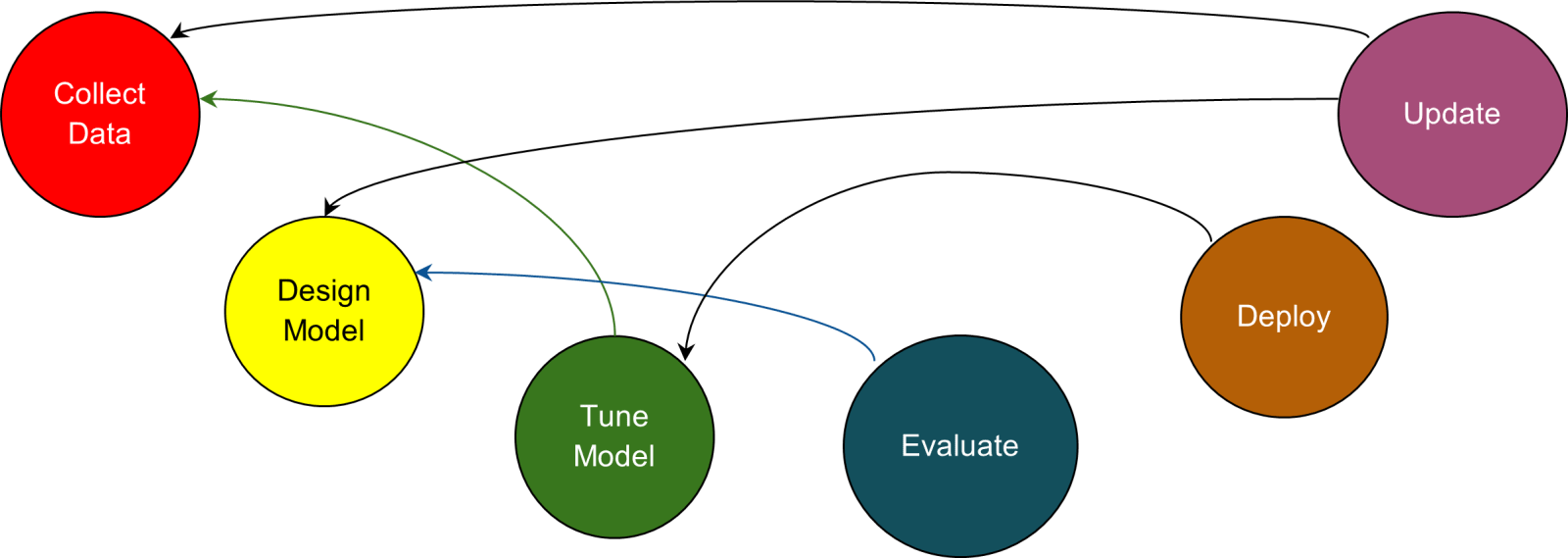
Following diagram depicts a typical AI/ML model lifecycle
The first and the most critical step is to acquire, prepare, label and manage large datasets. Depending on the application and the use case, appropriate ML models are developed and produced. Sometimes models aren’t written from scratch, pretrained models with related tasks (image recognition, sentiment analysis) are fine tuned to match current expectations. And multiple models get developed and tuned at the same time for the same use case, each individual model then gets evaluated for accuracy, precision (F1 score) and performance with some well defined preset metrics. The winning model gets deployed in a production environment, gleaning valuable insights from new data. With change being the only constant in the real world, the model is continuously monitored and measured using new outcomes. It is tweaked, updated and is eventually replaced when outputs no longer match business goals and objectives.
AI and Cloud
As can be seen, coming up with tangible ML models involves running many open ended experiments iteratively using intensive compute and storage operations. With proprietary hardware and software, the costs add up significantly in a short time with little or no rewards . The cloud offers reprieve, here are some benefits to use clouds to fuel your AI/ML models:
Pay-per-use pricing, enormous IT resources required to build ML models can be shut down once processing is done
Elastic infrastructure that can scale up and down depending on AI/ML workload burstiness
Instant access to ML optimized resources, large scale data stores and compute resources (GPUs/optimized VMs) can be acquired and accessed immediately without tons of upfront costs
Pre-built algorithms and pre-trained models that can be used for faster innovation
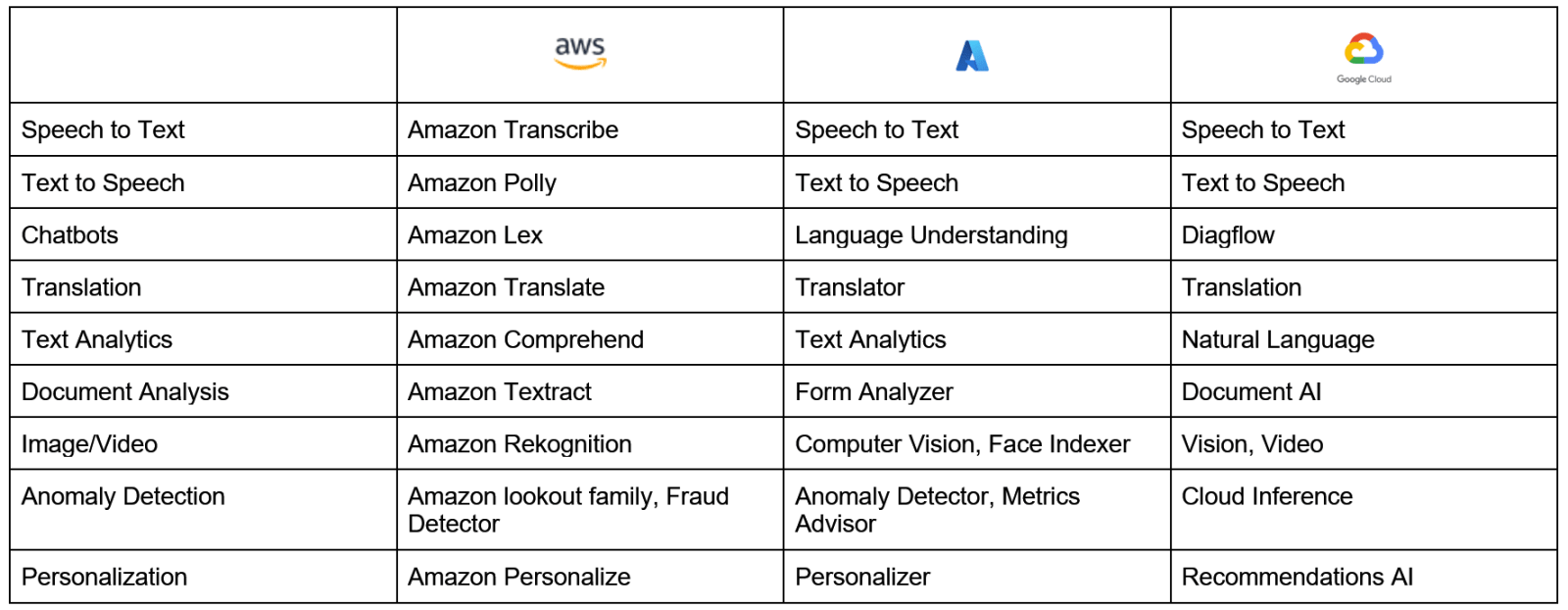
Also in recent years, the cloud providers have done some heavy lifting and offer various services for well known AI/ML problems, below is a brief summary:
AI/Cloud Challenges
The solid foundation required to build a robust ML model is data, and for a terrain as difficult as ML modeling, the foundation needs to be even sturdier. No matter how sophisticated the ML algorithm is, the results are directly tied to the quality and the quantity of the data that fuels it. And a lot of the data the organizations model is at the core of their business, the data typically includes consumer’s sensitive personal and identifiable information, health and financial records. Leveraging cloud services then raises the following concerns and needs:
Given the widespread access of the public cloud, the security risks associated with sensitive data gets amplified exponentially in the cloud
Regulations like PCI DSS and HIPAA require organizations to strictly limit access to protected data (credit card data, healthcare patient records) to only certain employees. This requires organizations to segment and isolate the network so employees with only legitimate needs can access the data
Enterprises store data in silos, in the cloud, on-premises and HDFS clusters. And not all AI/ML use cases are alike, organizations prefer (and require) a flexible hybrid cloud environment which meets all their AI/ML demands
Reliable network infrastructure that transfers high velocity data with minimal latency to implement real time transactions and analytics models
Ability to quickly detect and fix hotspots and blindspots in the cloud environment so that AI/ML models continue to thrive
Deploying AI/ML models in the multi cloud can look daunting at first, but with Alkira, you easily CAN.
Alkira – Network Infrastructure-as-a-Service
Alkira Network Infrastructure-as-a-Service is the industry’s first low latency, high performance global hybrid cloud network with security and application solutions, all offered as a service. Using an intuitive canvas or using IaC network automation, customers can get their branches, data centers, clouds and remote access users seamlessly and securely connected within minutes. Alkira’s unified management platform makes it very easy to deploy AI/ML models in a multi-cloud environment with all necessary security and policy controls. Here is how this can be accomplished:
Network Security Marketplace
Customers can choose from a wide range of security providers in the Alkira marketplace, the service is intelligently inserted and integrated into the cloud environment without additional routing overhead. All sensitive data that travels the length and breadth of the network is secured, sovereignty of the data isn’t lost. And as the volume and velocity of the data fluctuates, the instances scale up or down making the security (like compute, storage) truly elastic.
Network Segmentation
Network segmentation is the ability to compartmentalize a network into smaller domains, so different policy and routing controls can be applied on each of the domains individually. Native cloud constructs offer no segmentation, this makes data compliance and governance very difficult and very complex. With Alkira, network segments can be centrally carved out for the whole hybrid cloud making data compliance very easily achievable.
High Performance Network Connectivity
Alkira offers the best hybrid cloud infrastructure in the industry with an ultra high speed, low latency unified network backbone. Customers securely connect to the nearest Alkira point of presence (Cloud Exchange Point), with a fully meshed network backbone, live data can be used to drive real time ML models very efficiently. With Alkira’s architecture, geography is no longer a barrier, ML models can be globally present and do not have to be replicated to overcome hybrid cloud latency limitations.
Intuitive Visibility
Alkira provides an intuitive and holistic visibility into the entire multi cloud ecosystem. The portal presents a detailed view of network and application level statistics, a route visualization dashboard portraying the health of the control plane and several policy driven metrics. The solution also actively monitors network endpoints with synthesized probes; actionable alerts are sent so preventive or corrective actions can be taken immediately on anomaly or failure detection. The architecture ensures that a ML model never suffers performance degradation, data is made accessible at all possible times.
Resource Sharing
Data is increasingly getting distributed and siloed, to get the most accurate results from the ML model, the data needs to converge. Alkira offers resource sharing, the ability to selectively share certain resources from one segment to the other. A ML model can be trained and deployed in its own segment, data from different segments can then be shared to the ML segment, the model can then work on the whole dataset to produce a complete and accurate outcome.
Machine learning Ops (MLOps)
MLOps is the combination of Machine Learning and DevOps, and uses CI/CD practices to deploy ML models in production environments. MLOps not only aims to automate code deployment, it also aims to automate the collection of new data, retrain the model and analyze the results. Alkira offers a robust IaC offering, integrating Alkira’s IaC into the MLOps pipelines greatly simplifies new data collection and model retraining.
Conclusionds
AI/ML castle can and should be built in a hybrid cloud environment, and Alkira provides the best architecture for it. With Alkira, the castle’s foundation is strong, walls well fortified with abundant sunshine and visibility into all of the castle’s quarters and facilities.
Bharath is a seasoned campaigner in the computer networking industry. Currently, he is a lead engineer at Alkira and is responsible for designing & developing the Alkira test automation framework & infrastructure. Prior to Alkira, he held several lead engineering positions in Cloudgenix (SD-WAN App Fabric), Nuage Networks (SDN), Juniper & Cisco (Data Center and Storage). In his spare time, he enjoys reading, exploring Bay Area trails and playing tennis. He holds a Bachelors Degree from University of Madras, India and a Masters Degree from University of Illinois, Chicago. His twitter handle is @bchakrav.
Enterprise networks are expected to run 24/7, and the teams responsible for them need visibility wherever work happens. Cloud environments, partner connections, security services, and provisioning workflows are constantly changing. When something needs attention, network and operations teams need a fast way to understand what happened, assess impact, and take the right next step. That...
Enterprises are moving quickly on AI, but many are still running networking models designed for a slower, more centralized and static era. Today’s network has to connect clouds, data centers, campuses, branches, partner environments, and increasingly private AI infrastructure while enforcing consistent policy across all of it. That creates a new operational reality: every new...
The Digital Operational Resilience Act (DORA) is reshaping how financial institutions in the European Union manage operational risk related to information and communication technology (ICT). As the regulation takes effect, organizations must ensure that their critical ICT service providers support strong operational resilience, risk management, and oversight capabilities. For technology providers supporting financial institutions, this...




 The first and the most critical step is to acquire, prepare, label and manage large datasets. Depending on the application and the use case, appropriate ML models are developed and produced. Sometimes models aren’t written from scratch, pretrained models with related tasks (image recognition, sentiment analysis) are fine tuned to match current expectations. And multiple models get developed and tuned at the same time for the same use case, each individual model then gets evaluated for accuracy, precision (F1 score) and performance with some well defined preset metrics. The winning model gets deployed in a production environment, gleaning valuable insights from new data. With change being the only constant in the real world, the model is continuously monitored and measured using new outcomes. It is tweaked, updated and is eventually replaced when outputs no longer match business goals and objectives.