What is Alkira's approach to end-to-end network segmentation in multi-cloud environments?
Alkira provides a unified Cloud Network as-a-Service platform that enables end-to-end network segmentation across AWS, Azure, GCP, and on-premises resources. Segmentation is built-in and can be deployed in minutes without the need for hardware, software, or complex inter-cloud connections. The platform allows IT teams to group resources, enforce security policies, and manage segments and micro-segments through an intuitive drag-and-drop interface. Learn more.
How does Alkira simplify network segmentation compared to traditional methods?
Traditional segmentation is often manual, siloed, and error-prone, leading to security gaps and operational inefficiencies. Alkira eliminates these challenges by offering a unified platform where segmentation policies can be centrally managed and automatically applied across all environments. This reduces manual configuration, minimizes errors, and accelerates deployment. Segmentation can be implemented with just a few clicks, and resources can be grouped or micro-segmented for fine-grained security enforcement.
What are the key features of Alkira's network segmentation solution?
Key features include built-in segmentation, micro-segmentation for granular policy enforcement, integrated Zero Trust Network Access (ZTNA), next-generation firewalls, centralized visibility and control, and support for flexible use cases such as M&A integrations, remote user access, partner/extranet segmentation, and regional compliance. The platform also offers seamless integration with SD-WAN solutions like HPE Aruba EdgeConnect. More details.
How does Alkira support segmentation for mergers and acquisitions (M&A) and remote users?
Alkira enables rapid integration of new resources and architectures post-M&A by providing firewall-controlled access from extranet environments into the core enterprise network. For remote users, Alkira offers zero-trust segmentation based on login identity, ensuring only authorized users can access the resources they need. This approach streamlines onboarding and enhances security for distributed workforces.
How does Alkira's platform handle visibility and control for multi-cloud segmentation?
Alkira provides a single-pane-of-glass dashboard for monitoring, managing, and optimizing segmentation across all cloud and on-premises environments. IT teams can centrally manage policies, view network flows, and ensure compliance and governance from one unified interface.
Features & Capabilities
What measurable performance improvements does Alkira deliver?
Alkira reduces cloud setup time by 96%, network management time by 47%, and delivers up to 70% faster mean-time-to-resolution for complex issues. These improvements translate into faster deployments, streamlined operations, and significant cost savings. Source.
What integrations does Alkira support for network segmentation and cloud networking?
Alkira supports integrations with leading technology providers, including Cisco SD-WAN, Palo Alto Networks, Fortinet NGFW, F5, Splunk, ServiceNow, Infoblox, Aruba SD-WAN, Terraform, and Itential Automation Platform. These integrations enable secure, scalable, and automated networking across hybrid and multi-cloud environments. See all technology partners.
Does Alkira offer APIs for integration and automation?
Yes, Alkira provides APIs, including billing APIs that offer real-time cloud network cost data. These APIs can be integrated with other cost management tools and dashboards, supporting automated monitoring and optimization of cloud costs. Learn more.
What security and compliance certifications does Alkira have?
Alkira is SOC 2 and PCI-DSS compliant, demonstrating a commitment to securing customer data and maintaining robust operational controls. The platform also integrates advanced security features such as Zero Trust Network Access (ZTNA) and next-generation firewalls. Customers are encouraged to follow best practices for user access management. More on compliance.
What technical documentation and resources are available for Alkira?
Alkira offers a range of technical resources, including whitepapers (e.g., On Demand Next-Generation Cloud Firewalls), solution briefs, and a dedicated wiki. These resources provide in-depth technical insights and guidance for evaluating and implementing Alkira's solutions. Solution briefs | Wiki
Use Cases & Benefits
What business impact can customers expect from using Alkira?
Customers can expect significant operational efficiency, with up to 96% reduction in cloud setup time and 47% reduction in network management time. Alkira also delivers up to 40% lower Total Cost of Ownership (TCO) compared to traditional solutions, enhanced security, rapid scalability, and improved business resilience. See business impact.
What pain points does Alkira solve for enterprises?
Alkira addresses key pain points such as securing distributed workforces and applications, simplifying complex multicloud and hybrid cloud networking, providing comprehensive visibility and governance, and ensuring high-performance, scalable connectivity. These solutions help organizations reduce risk, accelerate digital transformation, and maintain control over their network infrastructure.
Who can benefit from Alkira's solutions?
Alkira is designed for mid-to-large enterprises across industries such as manufacturing, healthcare, telecommunications, financial services, biotechnology, software technology, retail, media & entertainment, and aviation. Target roles include Network Architects, Cloud Architects, Security Architects, IT Managers/Directors, CloudOps, CIOs, CTOs, and CISOs. See customer stories.
Can you share specific customer success stories using Alkira?
Yes. For example, Michaels transformed its network across 1,400 stores in record time, ensuring secure and seamless connectivity during peak season (case study). Koch Industries simplified multicloud networking and improved agility (video). Warner Hotels enhanced networking efficiency and visibility (video). Chart Industries improved agility and expanded globally (video). SITA integrated on-premises and cloud environments for aviation (video).
What feedback have customers given about Alkira's ease of use?
Customers consistently praise Alkira for its intuitive drag-and-drop interface and rapid deployment. For example, a network architect at a large manufacturer reported, "The IT DIY approach was going to take 6 months to be secure and redundant and all. Alkira did it for us in 3 days, and at very low cost." Matt Hoag, CTO at Koch Industries, said, "We had gone from a mass of complexity and months of work to a dashboard that allowed us simply to draw our network and deploy it in a few hours." See more testimonials.
Pricing & Plans
What is Alkira's pricing model and how is it determined?
Alkira offers flexible pricing, including consumption-based (pay-as-you-go) and commitment-based (fixed) options. Pricing is determined by the quantity and size of network elements (such as Alkira Cloud Exchange Points), connectors, next-generation firewalls, and data egress. Fixed hourly rates are available for specific connector types and bandwidth. Customers can view live pricing details from the portal or via APIs. See pricing details.
Competition & Comparison
How does Alkira compare to competitors like Aviatrix, Prosimo, Nefeli, and Cato?
Alkira differentiates itself by providing a true abstraction layer leveraging cloud providers' infrastructure, enabling single-click provisioning and eliminating manual configurations. Unlike Aviatrix (which focuses on orchestration overlays) and Prosimo (which is application-centric), Alkira delivers full-stack networking and security for both cloud and traditional use cases. Compared to Nefeli (agent-based, manual configs) and Cato (SD-WAN focus), Alkira offers a unified platform for multi-cloud and hybrid environments, integrated security, and global backbone-as-a-service. Learn more.
Why should a customer choose Alkira over alternatives?
Customers choose Alkira for its true abstraction layer, integrated security (ZTNA, next-gen firewalls), ease of use (drag-and-drop interface), rapid deployment (months to minutes), measurable ROI (up to 40% lower TCO), vendor-agnostic approach, and comprehensive visibility. Alkira allows free choice of security/network stack components without vendor lock-in. See detailed comparison.
Implementation & Onboarding
How long does it take to implement Alkira, and how easy is it to get started?
Customers can implement a proof of concept in as little as 4 hours, with full production deployment typically taking about 8 weeks. Alkira's drag-and-drop interface and dedicated training platform make onboarding straightforward, even for non-technical users. Training platform.
What training and technical support does Alkira provide for new customers?
Alkira offers a dedicated training platform with detailed guidance, demos, and resources. Customers also benefit from 24×7 monitoring, a diagnostics dashboard for troubleshooting, and dedicated support via email or support tickets. Training | Contact support
Support, Maintenance & Troubleshooting
What customer service and support are available after purchasing Alkira?
Alkira provides proactive notifications for maintenance, a diagnostics dashboard for live troubleshooting, 24×7 monitoring to meet SLA commitments, and dedicated support via email or support tickets. These services ensure minimal downtime and efficient issue resolution. Contact support
How does Alkira handle maintenance, upgrades, and troubleshooting?
Alkira informs customers in advance about planned or emergency maintenance, offers a diagnostics dashboard for network visibility, and provides continuous 24×7 monitoring. Dedicated support is available for resolving issues and minimizing operational disruptions.
Industries & Case Studies
What industries are represented in Alkira's case studies?
Alkira's case studies cover manufacturing (e.g., Chart Industries), retail (Michaels), healthcare, telecommunications, financial services, biotechnology/life sciences, software technology, media & entertainment (Warner Hotels), and aviation (SITA). Explore case studies.
Company Information & Vision
What is Alkira's vision and mission?
Alkira's vision is to transform enterprise connectivity by simplifying cloud networking for the AI era. Its mission is to eliminate the complexity of traditional hardware-dependent networking by providing a cloud-native solution that seamlessly connects hybrid and multi-cloud environments through a unified control plane. Company info.
What is Alkira's company background and industry recognition?
Alkira was founded by the creators of Viptela (acquired by Cisco in 2017) and has been recognized as a Gartner Cool Vendor, named among America’s Best Startup Employers by Forbes, and received awards such as the 2024 Excellence Award from Cloud Computing Magazine. More about Alkira.
Alkira simplifies end-to-end Cloud Network Segmentation for the Multi-Cloud Era
Summarize with AI
The time of digital transformation is upon us, and with it comes many exciting innovations that enterprise organizations are eager to adopt and deploy as rapidly as possible to gain the latest edge in cloud. As organizations look to deploy new technologies across their business, from software-defined edge solutions like SD-WAN to containerized applications at the core and mission-critical resources spread across multiple clouds, the amount of endpoints requiring carefully managed network and security connectivity has exploded exponentially.
Cloud Network Segmentation is a must for increased security and more efficient connectivity
Cloud Network segmentation plays a critical role in securing, scaling, and managing enterprise networks. With cloud network segmentation, IT administrators are able to group resources according to specific criteria, including type of network access needed, security rights and privileges, and routing requirements. This can help protect the core infrastructure of the business while safeguarding critical data.
Additionally, by segmenting the network organizations can better group resources in ways that maximize efficiency and provide tighter security and access controls. For example, a segment of partners may not require the same level of access as internal employees, or specific regional workforces may have unique security requirements. By partitioning and grouping, the utmost in control can be maintained, and Alkira’s highly-visible platform lets you accomplish even complex cloud network segmentation easily and with confidence.
Managing segmentation in a multi-cloud world is complex
The challenge in today’s multi-cloud world is that IT leaders are now dealing with multiple cloud architectures, each with its own cloud network segmentation design in place. Manually managing these disparate and siloed segmentation designs can quickly become complex, time consuming, and risky.
It’s not unlike spinning plates, with each cloud architecture spinning at its own velocity. At the end of the day, it’s a recipe for potentially costly security mistakes or operational inefficiencies leading to unforeseen charges. A new way of managing cloud network segmentation is needed.
Alkira: A unified end-to-end approach to simplify multi-cloud segmentation
At Alkira, we dramatically simplify and streamline cloud network segmentation across multi-cloud architectures. The Alkira Cloud Network as-a-Service platform provides IT with a unified center for managing, scaling, and operating multi-cloud network segmentation in a true end-to-end fashion.
The Alkira platform does this in three key ways. First, by virtue of our revolutionary approach to networking in which we bring together all aspects of cloud networking and security into one singular platform, Alkira is able to instantly simplify the approach to cloud network segmentation at any scale.
Simply put, cloud network segmentation is built-in and ready to be deployed with just a few clicks. No hardware to buy, no software to manage, no complex connection tricks between clouds required. It’s all part and parcel of the Alkira platform, and all delivered as a flexible and responsive service.
Figure: multi-cloud segmentation
With Alkira, cloud network segmentation automatically spans the entire network. This means that resources of any type, hosted on any cloud or even on-prem, can be simply and easily placed in a segment without the need for any time consuming manual processes or additional third party software or hardware to manage.
The easy-to-use Alkira platform gives IT direct visibility and control into the entire multi-cloud architecture of the business, as one converged environment with a centralized networking core. From this radically upgraded posture made possible by Alkira, resources can easily be grouped within segments or further grouped into micro-segments for a fine-grained security policy enforcement.
The sky’s the limit for how IT leaders can use the Alkira platform and its built-in unified cloud network segmentation. What in the past would be a time consuming project spanning multiple clouds and infrastructure stacks becomes a simple process.
The end result: more flexibility and agility for dynamically scaling cloud networking, and dramatically improved security posture for the entire business. By segmenting resources, you can greatly reduce the security attack surface, safeguarding critical elements and isolating vulnerabilities. Segmentation also provides internal barrier and contaminant, so if an intruder does manage to compromise one element of infrastructure, the entire network is not accessible and they do not have free range to pilfer mission-critical data.
Alkira Cloud Networking as a Service can also help simplify the networking segmentation process for Merger and Acquisition (M&A) environments. When companies merge or acquire new resources, IT leaders are now tasked with managing and integrating entirely separate IT architectures. Alkira’s flexible platform gives IT the agility to manage M&A resources easily and with high levels of security, providing firewall controlled access from extranet environments into the core enterprise network.
An additional use case Alkira has helped customers take on successfully is segregating remote user access. Remote work has exploded over the last few years, and Akira provides a zero-trust network access architecture to manage VPN users effectively, with segments based on login identities to make sure only authorized users are allowed access to the resources they need.
Alkira is continuously innovating to expand cloud network segmentation possibilities
The Alkira team is continuously developing new features and functionalities to help organizations better manage cloud network segmentation across multi-cloud architectures. For example, this month we introduced a suite of new Cloud Network Segmentation features in the Akira Cloud Network as a Service (CNaaS) platform.
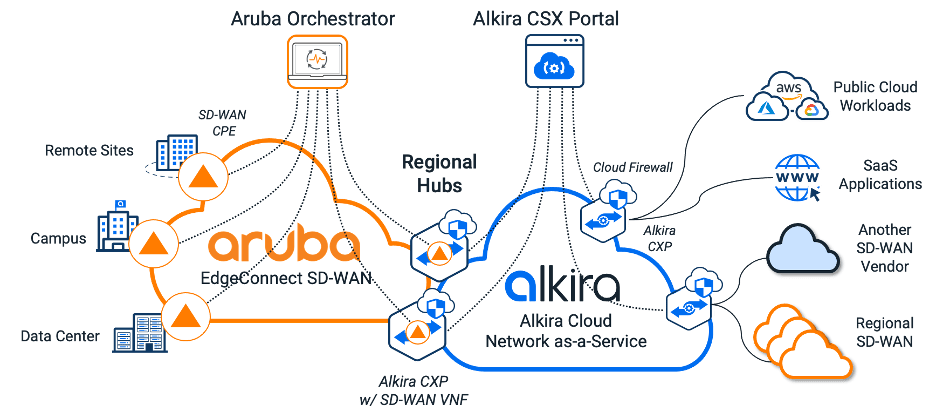
These new capabilities expand the already robust portfolio of segmentation services available via Alkira, with expanded integration for HPE Aruba EdgeConnect seamlessly incorporated into the Alkira platform, giving IT leaders new levels of segmentation control, visibility, and efficiency.
Figure: HPE Aruba EdgeConnect
In this example, EdgeConnect environments can simply and quickly be incorporated into the Alkira platform and SD-WAN segments can be seamlessly extended to multi-cloud environments, as well as the regionalized SD-WAN fabrics.SD-WAN segments can be seamlessly extended to multi-cloud environments, as well as the regionalized SD-WAN fabrics.
It’s just the latest example of how the Alkira platform continues to evolve and seamlessly connect any resource, and provide fast and easy tools for IT leadership to secure multi-cloud networking and use cloud network segmentation to power digital transformation with confidence.
Erik Radvon is Senior Product Marketing Manager at Alkira, where he helps to tell the story of Alkira Cloud Networking as a Service and how it revolutionizes connectivity for the multi-cloud world. Erik is a longtime technology professional, with 15+ years experience helping customers modernize their infrastructure and deliver better business outcomes. Prior to Alkira, Erik worked in converged and hyper-converged infrastructure at Dell Technologies, as well as playing lead roles in growing marketing for data centers, managed services, and cloud connectivity providers. Based in Boston, Massachusetts, Erik also has an accomplished background in journalism and creative writing.
Enterprise networks are expected to run 24/7, and the teams responsible for them need visibility wherever work happens. Cloud environments, partner connections, security services, and provisioning workflows are constantly changing. When something needs attention, network and operations teams need a fast way to understand what happened, assess impact, and take the right next step. That...
Enterprises are moving quickly on AI, but many are still running networking models designed for a slower, more centralized and static era. Today’s network has to connect clouds, data centers, campuses, branches, partner environments, and increasingly private AI infrastructure while enforcing consistent policy across all of it. That creates a new operational reality: every new...
The Digital Operational Resilience Act (DORA) is reshaping how financial institutions in the European Union manage operational risk related to information and communication technology (ICT). As the regulation takes effect, organizations must ensure that their critical ICT service providers support strong operational resilience, risk management, and oversight capabilities. For technology providers supporting financial institutions, this...




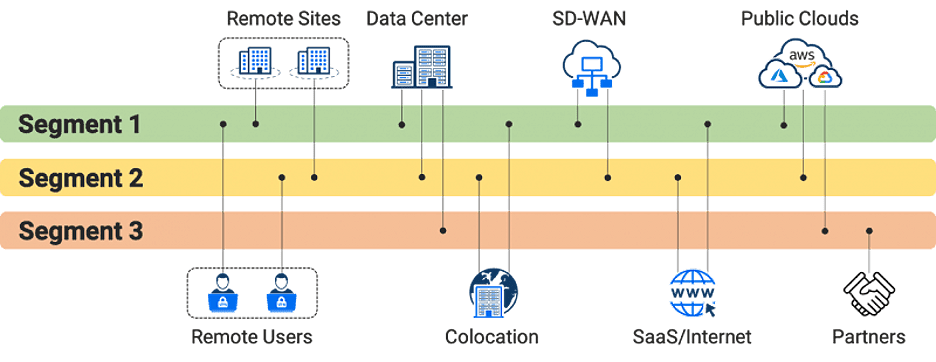 Figure: multi-cloud segmentation