The Market Speaks: When Industry Giants Follow Your Lead
Recently, Google announced the release of its own Cloud WAN (No it’s not the AWS Cloud WAN, it’s Google’s own Cloud WAN). This move highlights the growing demand for Cloud Delivered Network-as-a-Service (NaaS) solutions, which are essential for modern networks. Alkira pioneered this technology over six years ago and is happy to see Google and other CSPs validate the need for network infrastructure-as-a-service. Leading enterprises such as S&P Global, Koch, Chart Industries, Warner Hotels, and numerous others have already leveraged Alkira’s network infrastructure platform to address a wide range of use cases from network segmentation and backbone-as-a-service to multi-cloud connectivity, branch-to-cloud integration, partner onboarding, and beyond.
Why Network Infrastructure-as-a-Service Is Now Essential, Not Optional
The demand of Network as a Service delivered from the CSP is growing for two reasons:
1. High Capex and Lack of Agility with Traditional Networking
Enterprises are increasingly moving away from legacy networking approaches that rely on physical hardware, colocation facilities, and telco contracts. These methods often lead to high capex, deployment delays and expansion challenges. In contrast, cloud service providers (CSPs) have invested heavily in building agile, software-driven networks that offer on-demand scalability — enabling networking to become a true business enabler rather than a bottleneck. However, this shift to cloud-based infrastructure brings its own complexities, particularly in managing and securing connectivity across distributed environments. The introduction of AWS Cloud WAN, Azure vWAN, and now Google Cloud WAN, underscores the efforts of these giants to simplify their own intricate networks but don’t go beyond their network and services.
2. A Highly Distributed User and Application Landscape
Today’s users and applications are more distributed than ever. Users are connecting from anywhere home, branch offices, airports, coffee shops or on the go while applications reside in on-prem data centers or across multiple cloud providers. As a result, the traditional model of routing everything through centralized data centers no longer works. The network’s center of gravity has shifted to the public infrastructure, and enterprises must now build secure, scalable, and flexible connectivity across this dynamic landscape. Building an enterprise grade private network on top of public infrastructure is no longer optional, it’s a must have.
Beyond Cloud-Specific Solutions: Why Comprehensive Matters
When looking at the solutions from AWS, Azure, and Google, one key difference becomes immediately clear when comparing with Alkira’s solution, is each offering is designed to address a narrow set of use cases which only applies to its own cloud ecosystem. All of the CSPs based solutions are looking to solve the following two use cases.
Use Case 1: Leverage the CSP’s own network as backbone-as-a-service
Use Case 2: Simplify intra-cloud connectivity within that CSP’s environment
While these solutions may offer value within a single cloud, they create silos when enterprises operate in multi-cloud environments. Adopting a native CSP solution means being locked into that provider’s ecosystem. Ideally, enterprises should be able to unify and standardize all major cloud backbones under a single solution with a standardized transit across providers.
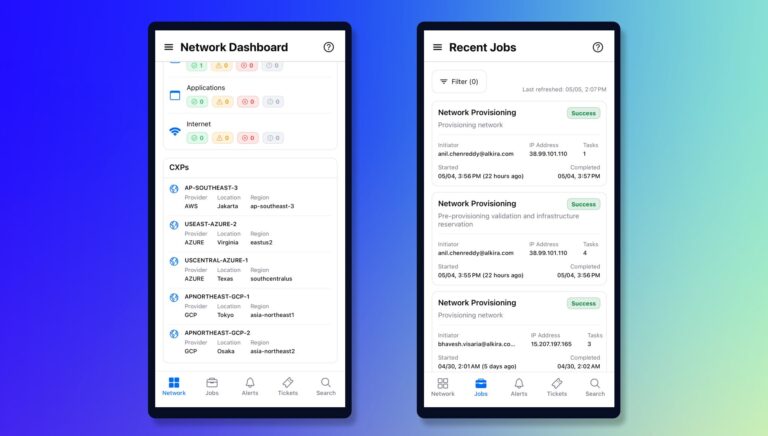
Take this example: if you have workloads in multiple CSPs hosted in Ashburn, VA, you shouldn’t need to deploy and manage separate gateways in each cloud and stitch them together manually. With Alkira, you can simply deploy an Alkira Cloud Exchange Point (CXP) in Ashburn that serves as a common transit hub for all your cloud providers — eliminating the complexity of inter-cloud connectivity and enabling seamless integration.
Furthermore, cloud networking and backbone-as-a-service are only part of the problem statement. Enterprise connectivity needs are broader and more complex. As organizations shift away from private data centers and MPLS-based models toward public infrastructure and the Internet, the requirement for a robust, enterprise-grade private network remains. What’s needed is a comprehensive network and security platform delivered as-a-service, one that handles advanced routing, segmentation, high availability, disaster recovery, partner integration, overlapping IP resolution, security enforcement, DDI services, and more. This is exactly where Alkira delivers — going beyond cloud-specific use cases to support the full spectrum of modern networking requirements with simplicity, agility, and enterprise-grade performance.
Please check Customer testimonials and an Independent Study by Nemertes which highlights Alkira’s claim of delivering a unified approach which has enabled customers to reduce complexity, accelerate deployments, and improve operational efficiency.
Conclusion: First to Market, First in Capability
The emergence of Cloud WAN solutions from tech giants like Google further validates what Alkira has championed for years that cloud-delivered Network infrastructure as-a-Service is no longer a luxury but a necessity. Alkira has been solving customer networking challenges with a unified, cloud-agnostic platform since 2020 while others are just validating the approach with siloed, cloud-specific solutions.
Alkira’s vision was clear from the start: deliver a seamless, scalable, and secure enterprise-grade network that spans clouds, regions, end-users, and on-prem networks, all delivered as-a-service. With Alkira, customers don’t need to compromise between agility and control, or between performance and simplicity.