

The New Network Operating Model: Operational Simplicity Is the Scaling Constraint in Network Modernization

Performance can be engineered. Complexity compounds.
For years, network modernization has centered on speed, bandwidth, and latency. Those metrics still matter, but they are rarely what holds enterprises back. At scale, operations fail before performance does.
As networks spread across clouds, regions, partners, and AI workloads, the leadership question shifts from “How fast is the network?” to “How hard is it to change safely?” More specifically: How many decisions, handoffs, and policy translations does one change require?
Complexity is the hidden tax on modernization
Every modernization initiative increases scope. Typical drivers include:
- New cloud environments and regions
- New partner connections and third parties
- New security and compliance requirements
- New AI data flows and workload patterns
In traditional architectures, each addition multiplies operational overhead:
- More configuration objects and templates
- More policy translations across platforms
- More toolchains and handoffs
- More change windows and approvals
- More failure domains to troubleshoot
The network may still function, but only through high operational effort. Over time, complexity becomes the dominant cost driver, even when infrastructure is fully depreciated.
This is why many enterprises feel slower after modernization projects: they increase capability without reducing operational burden.
AI exposes operational debt faster than anything before
AI initiatives compress timelines and raise the cost of mistakes.
They typically require:
- Rapid environment creation and teardown
- Frequent segmentation and policy changes
- Cross-cloud data movement
- Consistent performance without constant manual tuning
Networks built on manual intervention and fragmented control planes cannot keep up. Each AI iteration becomes gated by approvals, reconfiguration, and risk reviews.
AI doesn’t tolerate operational drag.
It turns slow networks into stalled strategies.
More tools often increases complexity
When complexity rises, the default response is to add tooling:
- More dashboards
- More automation scripts
- More overlays and point products
- More integrations between teams
This creates a paradox. Each tool solves a narrow problem while expanding the operational footprint. Teams spend more time coordinating tools than delivering outcomes.
Modernization succeeds only when complexity is removed at the architecture level, not managed at the edges.
What operational simplicity actually means
Operational simplicity is not minimalism. It is consolidation.
In practice, it looks like:
- One global control plane instead of multiple independent domains
- One policy and segmentation model instead of inconsistent policy translations
- One operating rhythm instead of per-environment processes
- One source of truth instead of reconciled views
When simplicity is designed into the network fabric:
- Day-2 operations shrink instead of growing
- Change velocity increases without increasing risk
- Teams focus on outcomes, not maintenance
- Scale becomes predictable rather than stressful
This is the same principle that made cloud operating models work at enterprise scale. Abstraction and consolidation reduce operational load as environments grow.
Executive diagnostic: does your network get harder to operate as it scales?
If two or more of these are true, your constraint is operational complexity:
- Adding a new region or cloud requires new tooling, new templates, and new approval paths
- Segmentation and security policy changes must be rebuilt differently in each domain
- Troubleshooting depends on multiple teams and “swivel-chair” workflows
- Change windows are shrinking, but the network still requires manual coordination to stay safe
- AI projects are blocked more by network change velocity than by compute availability
Modernization is incomplete if scaling reliably requires more people, more process, and more exceptions.
Takeaway
Networks rarely fail because they are too slow. They fail because they are too complex to operate safely at speed.
In the AI era, simplicity is not a nice-to-have. It is a prerequisite for scale.
The executive question is straightforward:
Does our network get harder or easier to operate as it grows?
If the answer is “harder,” modernization is incomplete.
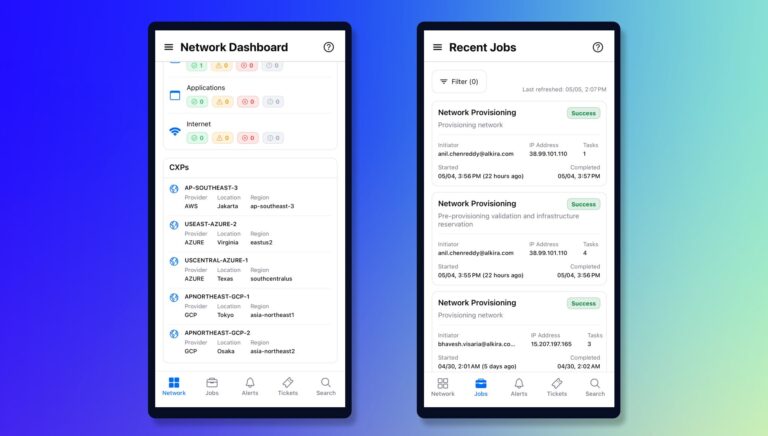
Where Alkira fits: Alkira delivers a cloud-based network fabric designed around a single operating model. It consolidates connectivity, segmentation, and governance into one globally consistent control plane so that expanding to new clouds, regions, and partners reduces operational effort instead of increasing it.
Read Part 5: “The New Network Operating Model: Economic Alignment for AI-Era Networking”
FAQs
Further reading
“A New Operating Model” Blog Series
- Part 1: The New Network Operating Model: Modernizing Beyond Colocation Hubs
- Part 2: The New Network Operating Model: Network Infrastructure-as-a-Service
- Part 3: The New Network Operating Model: Security From Day 0
- Part 4: The New Network Operating Model: Operational Simplicity Is the Scaling Constraint
- Part 5: The New Network Operating Model: Economic Alignment for AI-Era Networking
- Part 6: The New Network Operating Model: The Modernization Strategy That Reduces Risk
- Part 7: The New Network Operating Model: Network Modernization Use Cases
- Part 8: The New Network Operating Model: Measuring Network Modernization
- Part 9: The New Network Operating Model: The Objections That Stall Modernization
- Part 10: The New Network Operating Model: The Path Forward
Technical “Building A New Operating Model” Blog Series
- Technical Blog Part 1: “Building A New Operating Model: The Architectural Evolution of an Enterprise RAG System”

Calvin Nguyen