

Enterprise AI fails without a network that can keep up. The network must become the intelligent delivery layer for AI. Alkira has built an agile, elastic, secure (AES) -aaS network track for the AI era and beyond.
Static, insecure, unreliable, inflexible delivery is strangling enterprise AI. As models, agents, and data span clouds, regions, partners, and the edge, only a predictable, secure, and hyper-agile network keeps AI outcomes on track. That’s the job we built Alkira to do: turn complex, fragmented infrastructure into an on-demand, AI-powered, and policy-driven network fabric you consume, not build.
The Problem We Chose
A career building networking solutions for large enterprises taught me a simple truth: complexity compounds at every boundary—cloud to cloud, region to region, partner to partner. Teams don’t fail because they lack skill, but rather they stall because stitching it all together is slow, fragile, and expensive to operate at scale. After Viptela, it was obvious the cloud era needed something different: a unified control plane and an as-a-service network infrastructure that abstracts the plumbing and exposes intent. That insight is why we started Alkira.
Alkira’s Vision For The AI Era and Beyond
- Elastic and scalable. Network infrastructure should work like the cloud—up in minutes, on demand, and free of appliances to rack or agents to manage. Your teams define policy and outcomes while the platform handles the heavy lifting.
- Unified control, zero-trust by default. A single control plane that spans clouds, DCs, edge sites, regions, and partners—with zero-trust segmentation and service chaining built in—beats a patchwork of boxes and scripts every time. If policy is the source of truth, the fabric must enforce it consistently end-to-end.
- Predictable performance. Compute and data clusters distributed on cloud and on-premises, data lakes, agents, and users require predictable paths—not best-effort hairpins.
- Operate with (and for) AI. Networks shouldn’t merely carry AI—they should use AI to help design, build, operate, and verify networks. Copilots and agent frameworks belong in NetOps to explain changes, validate compliance, plan capacity, and turn natural-language intent into safe, auditable actions.
What This Looks Like in Practice
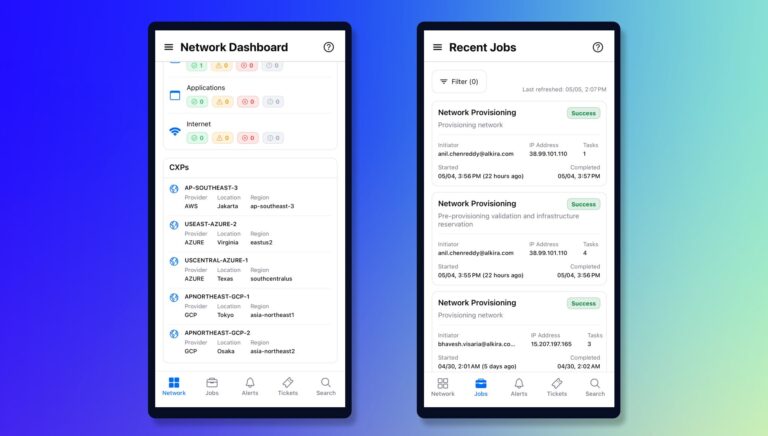
- A global fabric you consume on. You snap into a carrier-class backbone and Cloud Exchange Points (CXPs) that deliver high-throughput, low-latency paths across clouds and regions—no overlay sprawl, no hidden hairpins. You get reach without reinventing routing.
- Policy as product. You declare segmentation, connectivity, and service chaining once; the platform keeps it enforced everywhere, with continuous verification. When an app moves, policy follows—no migration war rooms.
- AI-ready operations. Our MCP-based server and Network Intelligent Assistant (NIA) bring explainability to networking. Ask in plain language; get validated actions and artifacts your auditors will sign off on. This isn’t a toy UI—it’s guard-railed automation.
Why Now
Cloud expanded the surface area. AI multiplied the stakes. The cost of misconfiguration is no longer a slow user ticket—it’s models starved of data, edge pipelines broken by latency, and governance risk at every boundary. Enterprises need the outcome of a well-run global network without the drag of building and maintaining one. That’s what NIaaS delivers.
What We’ve Learned (and Kept)
I’ve always admired Cisco’s focus on building at carrier scale and earning trust in the enterprise. We carry that respect forward—and pair it with startup velocity and ruthless simplification. The result is a platform opinionated about outcomes, humble about operations, and relentless about customer time-to-value.
What “AI-Ready Networking” Looks Like
- Hyper-agile with minutes to value, not quarters to deploy.
- Zero-trust by default, not a bolt-on afterthought.
- Deterministic paths end to end, not accidental hairpins.
- Unified policy everywhere, not a per-cloud patchwork.
- Future-proof as a service, not rip-and-replace at every refresh.
- Auditable, AI-powered automation, not brittle scripts to maintain.
The Road Ahead: Supporting AI, Powered by AI
The network fabric of the future needs to support AI and be powered by AI—policies expressed as intent, continuously verified, and executed by AI-assisted workflows that are explainable and reversible by construction. Your network adapts to the application graph and the data graph—not the other way around. The fabric needs to support an “anywhere-to-anywhere” agentic traffic, and it needs to do so in a dynamic and secure manner. This network fabric will also not rely on humans building networks, but human managing and verifying AI that build and operate networks. That’s how the network becomes the delivery layer for AI and remains relevant long after today’s architectures evolve.

Amir Khan